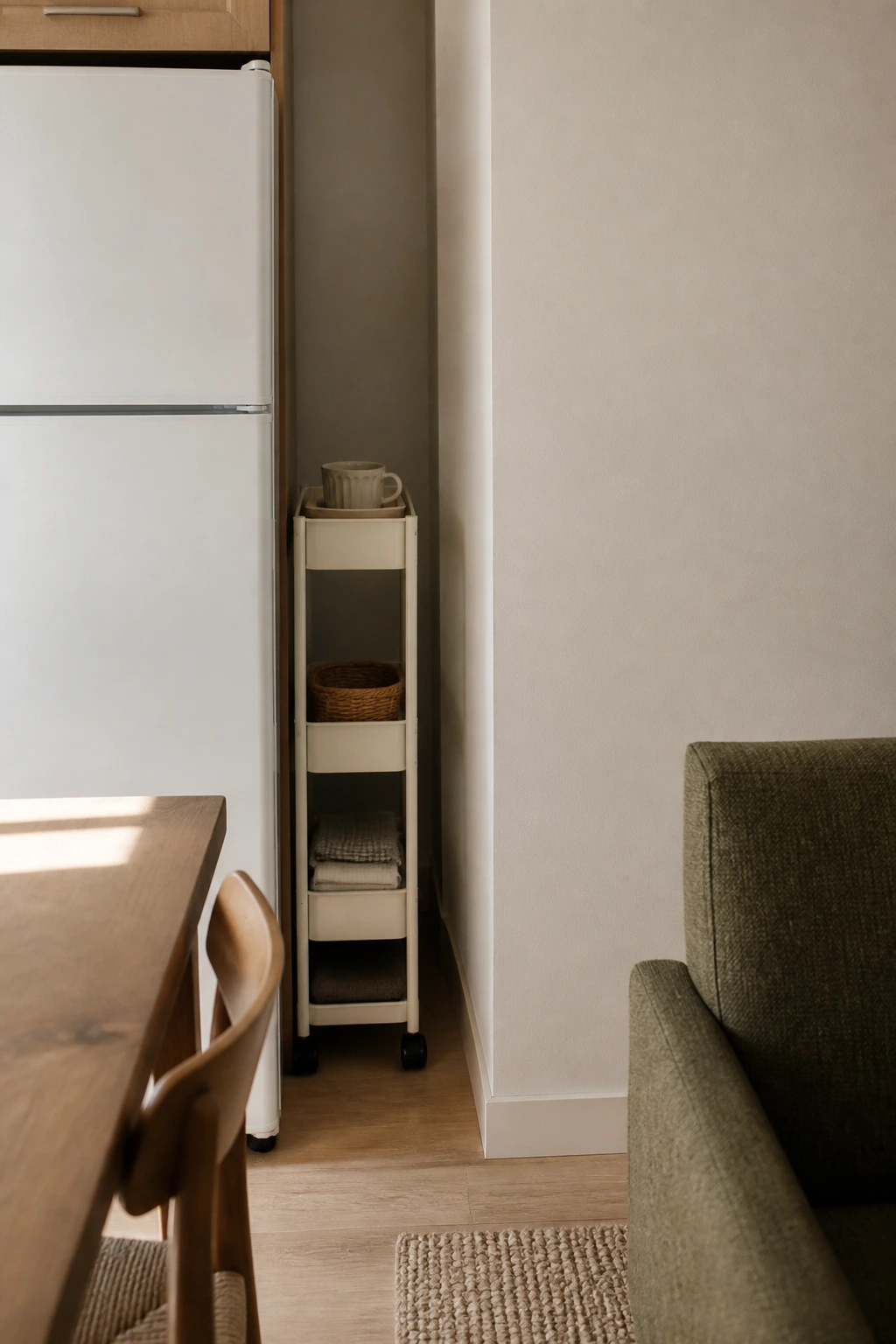
What should become easier the next time you come home?
A slim rolling cart can turn an awkward gap into useful storage—but only if the gap is genuinely available. The first question is not which cart looks best. It is whether the cart can reach the space, fit at every height, and leave the room usable afterward.
Room to Settle is currently researching real Amazon listings for this category. The comparison page records the candidate products, source status, and unresolved evidence gaps without inventing prices, ratings, or product test claims.
See the narrow-gap storage comparison
Measure the gap at more than one point
Measure the depth, width, and height at the floor, middle, and top of the proposed space. Trim, counters, pipes, baseboards, appliance edges, and sloping walls can make one part of a gap smaller than another.
Use the smallest usable measurement as the starting point. Then account for the space needed to grip the handle, pull the cart out, clean behind it, and remove it later.
Measure the route, not only the destination
A cart that fits beside the refrigerator may still fail at the doorway, turn, stairs, or elevator. Measure the narrowest part of the route from delivery to the final position. Include packaging if you are collecting it yourself, and check whether the cart can turn without scraping walls or furniture.
For a rental, the route also includes the space needed to clean and inspect the wall, floor, appliances, pipes, vents, and baseboards. Do not wedge storage into a service or airflow area just because the object fits.
Decide what the cart must actually do
A three-tier cart may be useful for small, light items that need to move together. It is not automatically a good pantry, appliance stand, or heavy-load shelf. Write down the actual category before comparing listings:
- daily cooking items;
- bathroom or laundry supplies;
- craft or office materials;
- cleaning products;
- small items that need to move between rooms.
The category changes the useful shelf height, access pattern, cleaning needs, and stability requirement.
Check the exact Amazon variant
Amazon listings can contain multiple colors, tier counts, dimensions, and sellers under one product family. Match the exact ASIN and variant before recording a dimension or price. A search-result title is not enough evidence for a publishable comparison.
The current Room to Settle research queue therefore separates:
- dimensions supported by an official brand source;
- dimensions found only in an Amazon or secondary listing;
- variant data that does not yet match the US Amazon listing;
- products that still need manual confirmation.
Until that evidence is complete, the page should not call one cart the winner.
Try the no-buy test first
Mark the proposed footprint with painter’s tape, paper, or cardboard. Place a box or basket inside the outline and live with the route for a day or two. Try pulling it out while carrying the items that normally travel through the room.
If the outline blocks a door, cleaning path, appliance access, or the way you turn, a slimmer cart may not solve the problem. The right answer may be reducing the category, using an existing surface, or leaving the gap empty.
What the future comparison will include
Amazon Associate links are now active for the research candidates on the comparison page. The links do not turn an incomplete product record into a recommendation: exact variants, current prices, ratings, availability, and fit evidence still need to be confirmed before any product is presented as a winner.