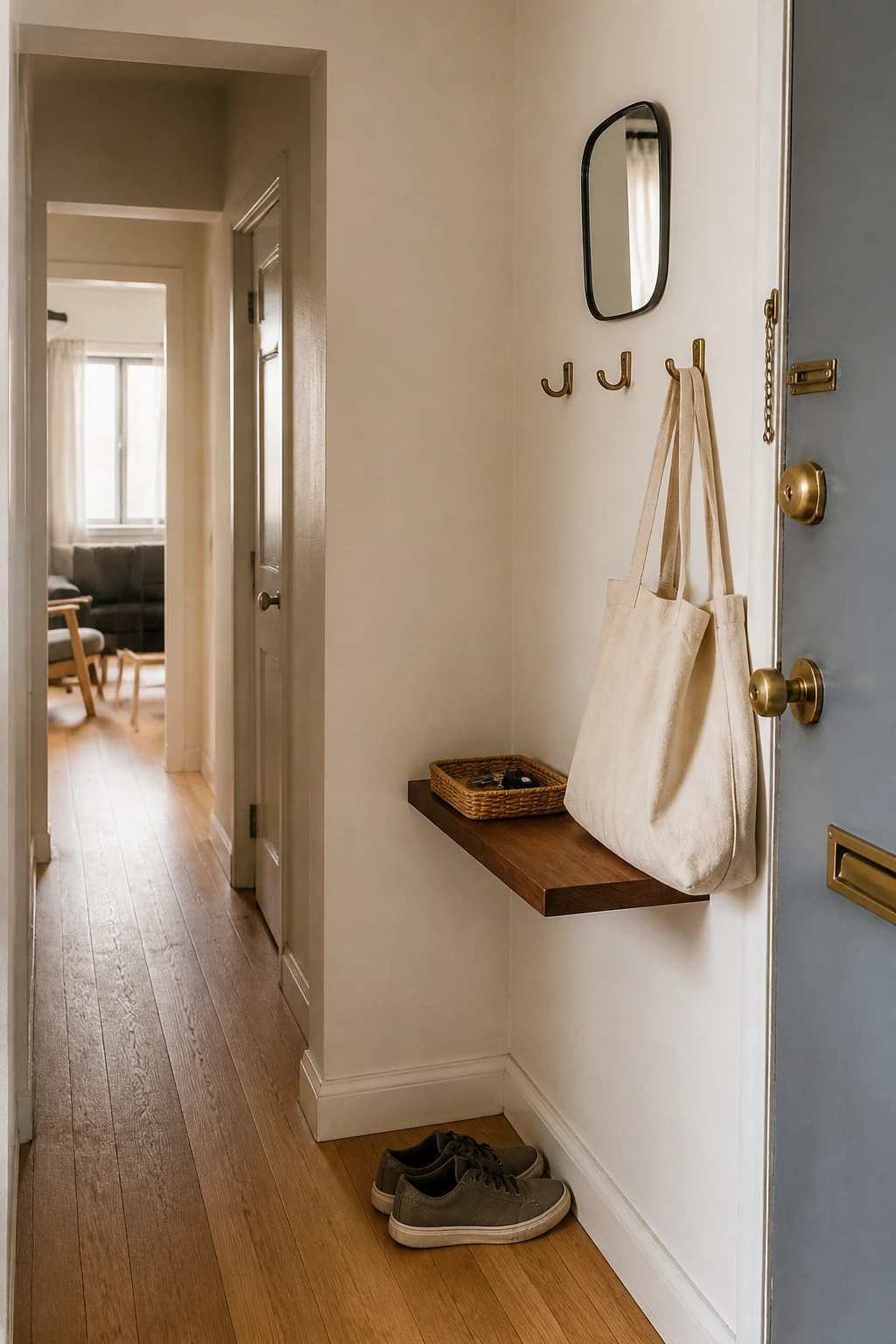
Watch one complete routine before measuring or buying.
Protect the route, opening parts, and exit plan.
Measure and rehearse
Use your room as the standard.
The numbers below are examples of what a reader might measure, not universal clearances. Your household, lease, building instructions, and access needs decide what works.
- What to measure
- Open the door as far as it normally travels, then measure from that arc to the nearest wall or object at the tightest point. Also measure the surface you naturally reach, rather than the full wall beside it.
- Clearance and access
- Walk the route carrying your usual bag or groceries. The useful clearance is the space your household actually needs to enter, turn, and close the door without stepping around storage.
Before you add anything
Ask three room-specific questions.
Write the answers beside your measurements. A choice that misses one of them is easier to rule out before it reaches the room.
- 01
Where does the door travel?
- 02
What arrives and leaves every day?
- 03
Which existing surface is easiest to reset?
No-buy test
Prove the routine before the purchase.
Borrow a tray, bowl, tote, or small box you already own and place it on an existing surface for a one-week test.
Low-commitment paths
Change one part, then observe.
These are starting paths, not promises that one setup fits every home.
- 01
Assign one existing surface or container to keys and the daily bag.
- 02
Move occasional shoes and deliveries beyond the arrival route.
- 03
Observe the landing routine for a week before adding capacity.
Decision boundaries
Know the compromise and the stop sign.
Renter-aware does not mean risk-free. Check the property rules, instructions, surface, access, and consequences before committing.
- Renter-aware path
- Prefer an existing surface or a stable freestanding container. If you consider adhesive hardware, check the lease and maker instructions, test only where permitted, and assume paint or finish may still be affected.
- Trade-offs
- A shallow landing zone holds less, but it protects the route and exposes what does not belong there. More shoe capacity can quickly make cleaning and door access harder.
- Who should avoid this path
- Skip added entryway storage if the only available footprint sits inside the door or walking route. Also avoid unstable stacks and wall mounting when the surface, allowed load, or removal result is uncertain.
Practical example — illustrative, not a standard
Put the measurements into a real decision.
If you measure 31 inches from the open door edge to the opposite wall, lay paper or cardboard over a 7-inch-deep zone on the floor. Walk through with a bag; if your shoulder or feet cross the outline, keep the landing point on an existing surface instead.
The common thread
Measure first. Keep the exit plan visible.
The Fit Check helps you decide whether a solution still works when the room changes, the lease matters, or the routine gets busy.
Read the Fit Check method