
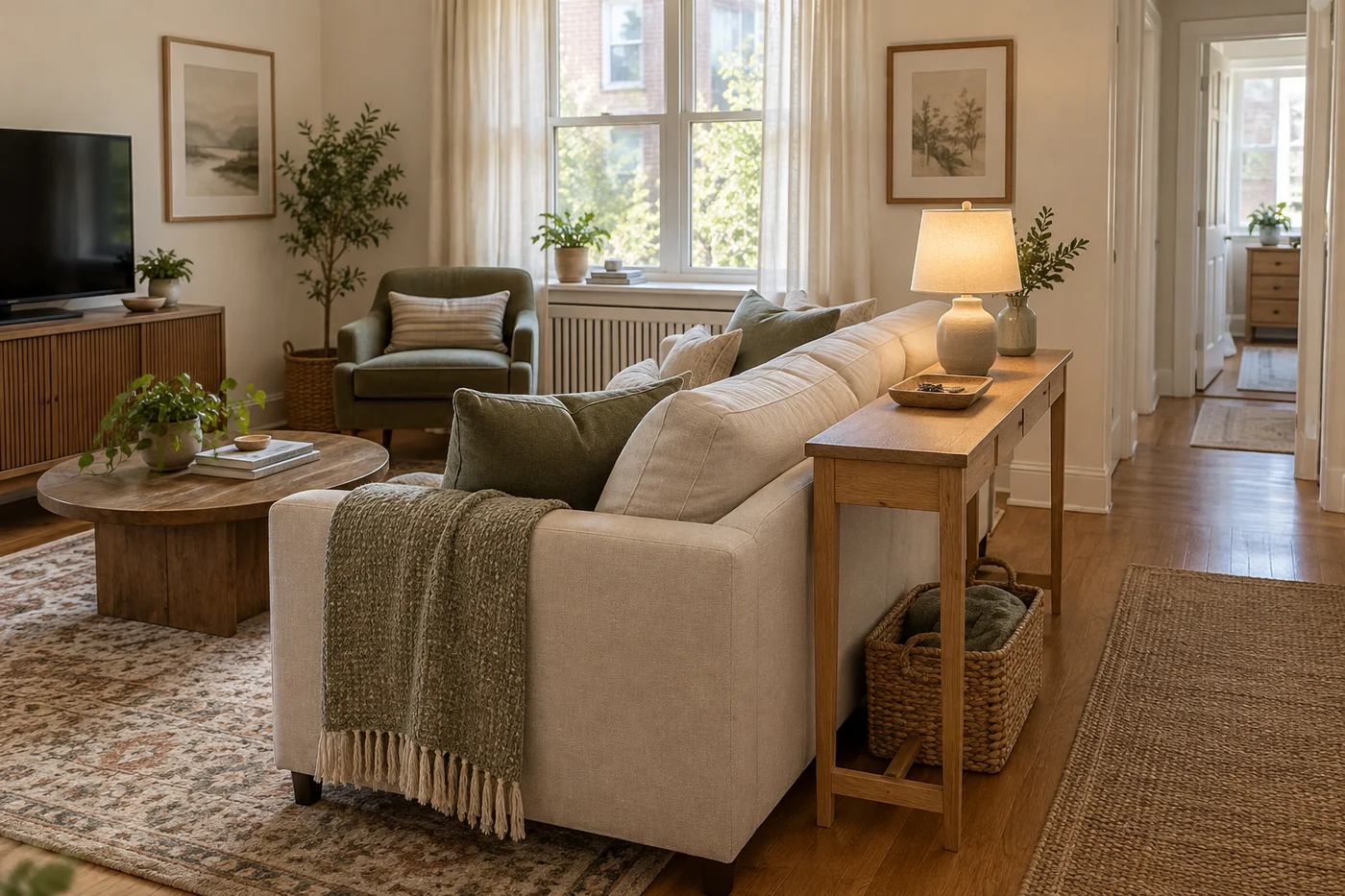
The most useful behind couch storage ideas start with access. A narrow console works when you can reach its shelves from a walkway. Low boxes can work in a wall-to-sofa gap when you can pull them out from an end. If either arrangement makes you move the couch every day, put your everyday belongings somewhere else.
Before adding furniture, decide what you want to store and how you will get it back. That small decision prevents a hidden storage area from becoming a place where things disappear.
Work out what kind of gap you have
Look at the sofa from the side. Is its back against a wall, or does it face another part of the room? Those layouts need different answers.
A wall gap normally offers access from one or both ends. You may be able to reach a top surface over the sofa, but reaching through cushions for a box is a different task. Keep that distinction in mind when planning what goes where.
A floating sofa has a more accessible back. A shallow open console can divide the sitting area from a dining space while keeping baskets within reach. However, the console also takes space from that passage. Count the passage as occupied space even when it looks empty in a photograph.
A recliner or sleeper sofa adds another constraint. Run its full opening sequence before marking a storage area. Keep new storage outside the movement envelope specified by the furniture manufacturer. A gap measured with the sofa closed does not prove clearance when it opens.
If the gap is beside a radiator, heater, or air vent, look up the equipment’s clearance requirements. Do not treat the entire strip as available storage simply because a basket fits there.
Measure the access route as well as the space
Write down three sets of measurements: the storage footprint, its entrance, and its retrieval route.
Measure the gap at both ends and in the middle. Baseboards, sofa legs, an angled back, and a window sill can make the usable shape different from the floor outline. Check height at the narrowest point if a container will slide below the back of the sofa.
Next, measure where the container enters. A box that fits inside may not pass a sofa leg or side table. Note whether the handle adds depth and whether a lid needs room to open.
Finally, place an empty box where you expect to retrieve storage. Pull it out, stand where you would sort its contents, and put it back. Can you do that without blocking a doorway or moving another piece of furniture? This is a planning check for your room, not a guaranteed fit formula.
For a new console, mark its footprint on the floor with removable markers that suit the floor finish. Walk through the room carrying a laundry basket or shopping bag. If that ordinary trip becomes awkward, choose a shallower arrangement or leave the passage alone.
Match the arrangement to the contents
| Arrangement | A useful job | Main limitation |
|---|---|---|
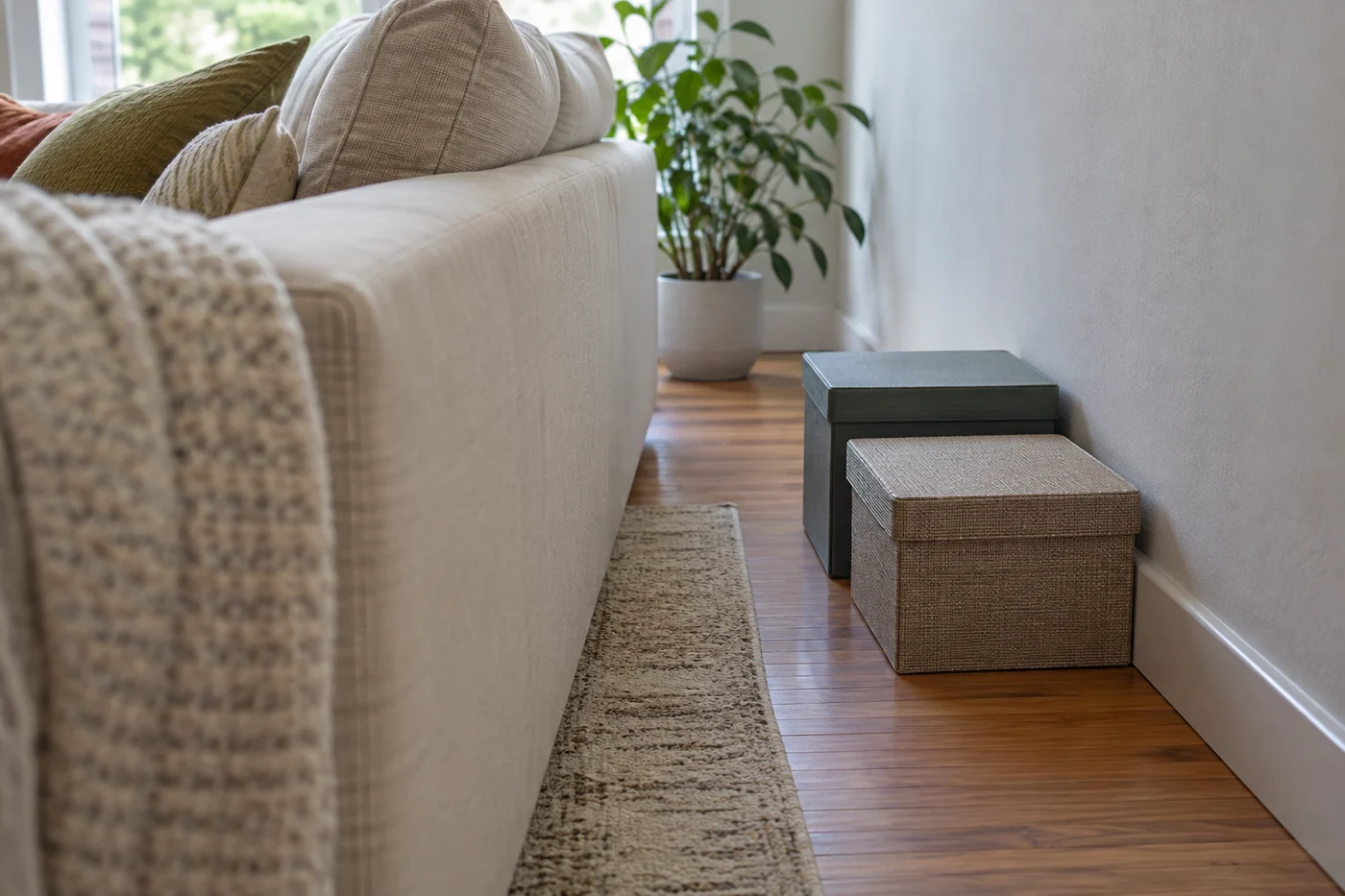
| Low removable boxes | Occasional games, spare throws, seasonal decor | Needs a clear pull-out route |
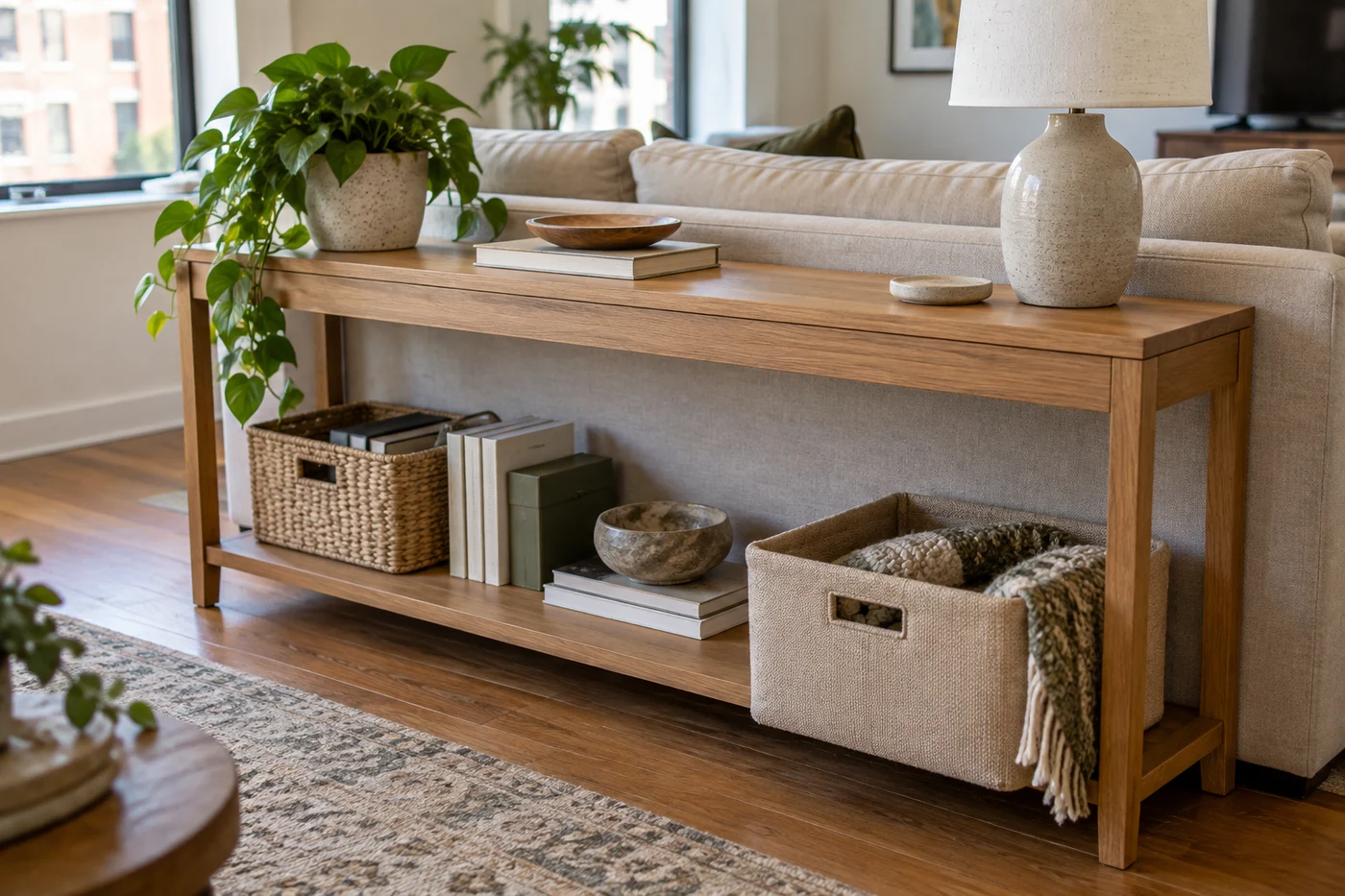
| Open console with baskets | Regularly used living-room items | Shelves must face accessible space |
| Shallow cabinet | Concealed storage behind a floating sofa | Doors and drawers need opening room |
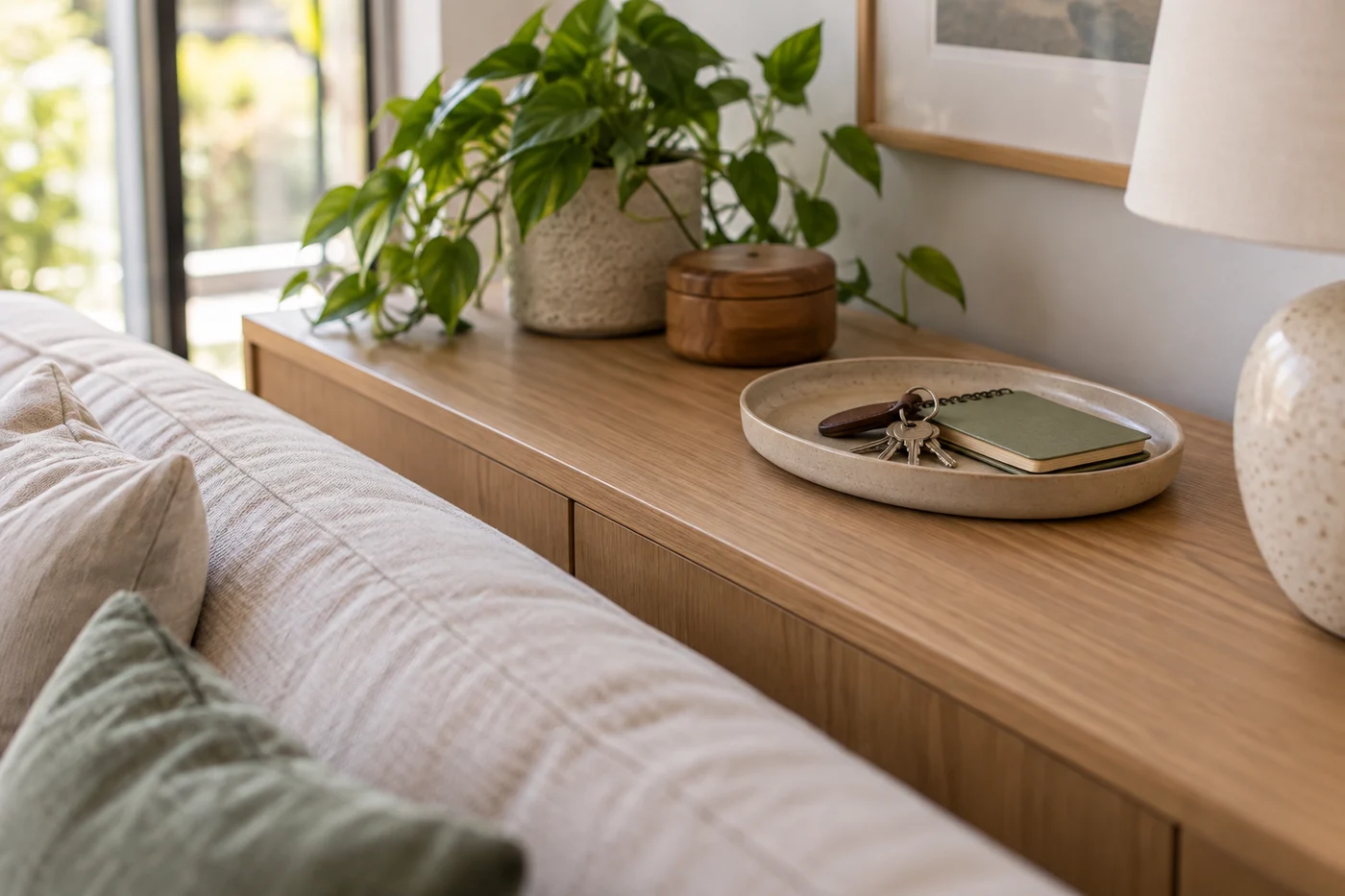
| Top surface only | A small tray for current reading | Does not solve bulk storage |
Choose low boxes when you already have an end opening and want occasional storage. Group by a task, such as movie-night supplies or a complete board game collection, rather than filling every box with unrelated leftovers.
Choose an open console when a shelf can face a usable walkway. Put the items you reach for most on the easiest shelf. Leave space above a basket so you can lift it out without scraping the underside of the table.
A cabinet is useful only when you can open it. Measure the drawer’s extended position or the door swing, then check the room again with the cabinet open. A long shallow cabinet that faces the wall creates concealed storage you may never conveniently use.
A tray on top can hold a current book and remote, but avoid turning the whole ledge into a display. Each extra object reduces the space available to set something down. IKEA’s unusual-space storage ideas demonstrate the broader principle of making storage serve a specific overlooked area. You still need to check access in your own layout.
Give every container a retrieval job
Pull out the items you intend to move behind the sofa and sort them into daily, occasional, and seasonal groups.
Daily belongings belong where a seated or standing person can reach them directly. If the sofa blocks that access, move those items to an end table, accessible basket, or another storage zone. Keep the hidden strip for belongings that do not need constant attention.
Occasional belongings can go into one container per activity. Keep a game with its pieces and instructions. Store a spare throw separately from paperwork. A useful label tells you what you will retrieve, rather than announcing that a box contains miscellaneous things.
Seasonal belongings should have a review date or a clear reason to stay. If you cannot name when you will use something again, behind the sofa may just hide an unresolved sorting decision.
Keep the first arrangement modest. Put one empty container in place, load it with its assigned belongings, and check retrieval again. A box may be comfortable to lift empty and awkward once packed. Divide contents if necessary instead of adding a claim about how much the container ought to hold.
Keep cords, furniture restraints, and cleaning access visible
A console can hide an outlet, but it should not hide a damaged or pinched cord. The US Fire Administration advises against placing cords where furniture can damage them. Route cords so you can inspect them and unplug equipment without dragging a loaded unit. See its appliance and electrical guidance.
Do not use the sofa as a substitute for a required furniture restraint. Follow the storage furniture’s assembly and anchoring instructions. CPSC’s Anchor It guidance explains the importance of preventing furniture tip-overs. If your lease prevents a required attachment, choose a different arrangement rather than leaving it out.
Make sure you can remove the containers and clean the floor. Keep the path to vents and outlets clear. Avoid placing spills, plant drainage, or damp textiles in a hidden area where you would not notice a problem quickly.
Check the arrangement after ordinary use
After you have used the area through a normal week, look for friction. Are baskets left out because returning them is awkward? Are belongings accumulating on top because their assigned box is difficult to reach? Does the sofa move into the storage when someone sits down?
Fix the cause rather than adding another organizer. Change the container orientation, move daily items elsewhere, or remove one box to create access. The successful arrangement is the one you can use and reset without rearranging the room.
For belongings that belong in a bedroom instead, use the broader clothes storage without a closet guide. The strip behind your sofa does not need to carry every storage problem in your home.
Common questions
Should a sofa table be the same height as the couch?
Compare its height with the sofa back and your intended use. Check that you can reach the surface comfortably and that objects are not in the way when you sit or recline. There is no single height that proves a table fits every sofa.
What if the space is too narrow for furniture?
Use it only if a removable container can enter and come back out. If it cannot, leave the gap clear. A nearby accessible storage area is more useful than a hidden box you cannot retrieve.