
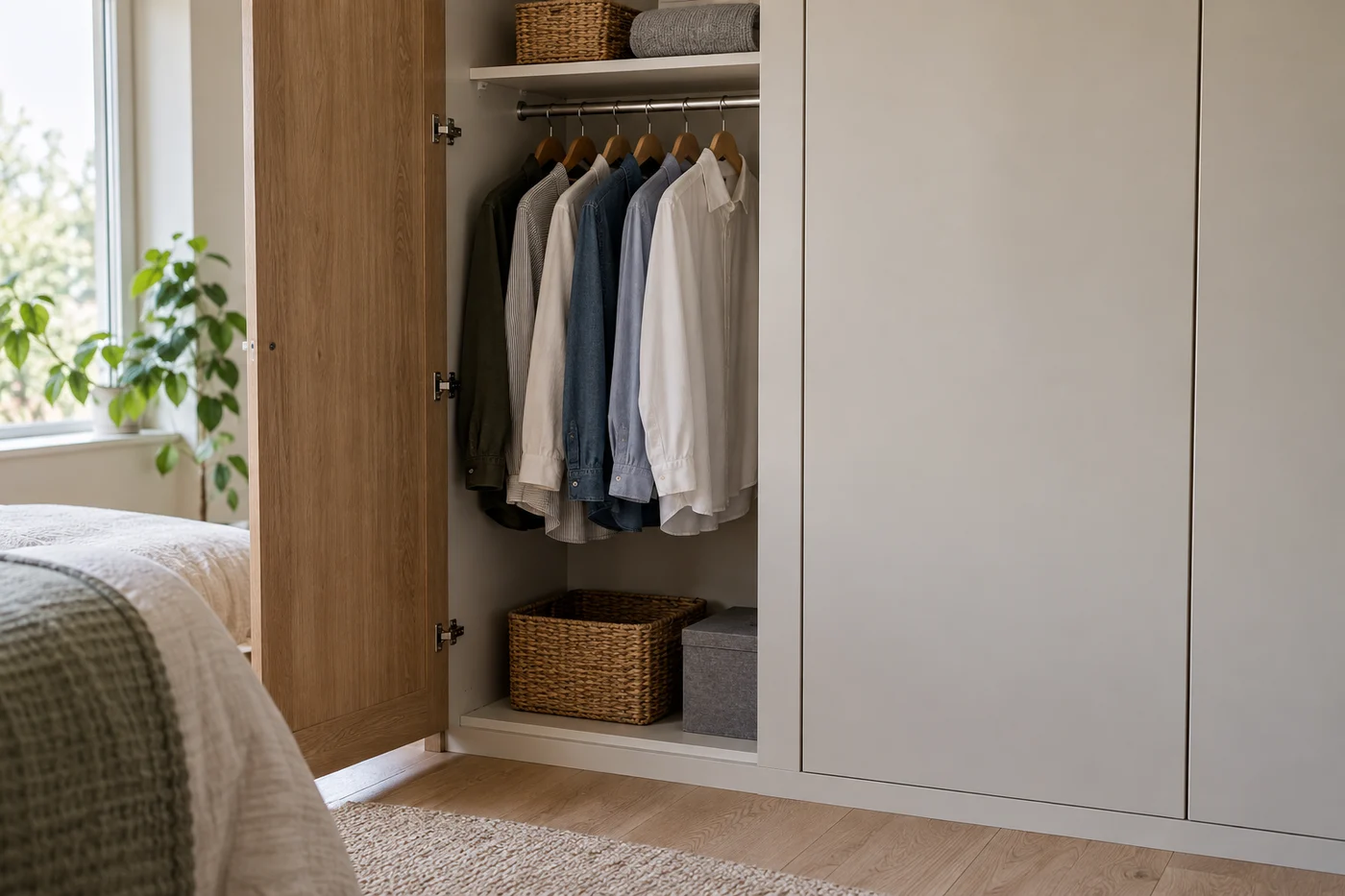
For conventional side-to-side hanging, 24 inches is a useful closet-depth planning reference, but the fit depends on clear internal space, your hangers, garment bulk and the door system. Measure from the finished back surface to the nearest inward obstruction with the door closed. Then check clothing on its actual hanger.
A shelf depth, a wardrobe’s external depth and the space needed by hanging garments are different measurements. Do not use one as a substitute for another. This guide helps you assess an existing closet or discuss a proposed one; it does not establish a universal legal minimum.
Depth is one part of the fit. Once hanging garments have room, use the small closet organization guide to assign folded clothing, shoes, and reserves.
Understand what the 24-inch reference means
The historical Michigan State University Extension publication Household Closets identifies 24 inches as a minimum depth for conventional hanging so clothes do not brush the wall or door. Treat this as planning guidance from an older publication, not a current building-code requirement.
A current manufacturer guide from California Closets describes reach-in closets as typically 24 to 30 inches deep. Typical dimensions still do not confirm that a particular garment will fit your space. Panels, doors and the layout inside can reduce the useful clearance.
If you are planning construction, ask the designer or installer to specify finished clear dimensions and the intended hanging arrangement. A rough wall opening or overall cabinet size does not answer that question. Verify any applicable local requirements separately when legal or construction compliance matters.
Use the reference to recognize a potential fit problem early. Then check the actual space rather than rounding an awkward measurement up to a familiar number.
Measure clear internal depth
Start at the finished back wall or cabinet panel. Measure forward to the nearest point that can restrict a hanging garment: a closed door panel, projecting hinge, track, internal handle hardware or another obstruction.
Take measurements at the rail height and other places the clothing occupies. A hinge may project only in one section. A back panel may not be flush with the surrounding wall. Record the tightest relevant depth rather than taking a single convenient measurement near the floor.
Distinguish these measurements in your notes:
| Measurement | What it describes | Why it can mislead |
|---|---|---|
| External wardrobe depth | Overall cabinet front to back | Includes panels and may omit projecting handles |
| Clear internal depth | Usable space inside the closed enclosure | Can vary near tracks and hinges |
| Shelf depth | Depth of a particular storage surface | Hanging clothes may extend past its edge |
| Loaded garment depth | Front-to-back envelope of clothing on a hanger | Changes with garment shape and hanger orientation |
For a doorless closet, measure the intended storage boundary as well as the physical back wall. Clothing can project into the room or walkway even when no door stops it. Removing a door changes the obstruction; it does not make the clothing occupy less space.
Check the hanger with clothing on it
Measure your widest relevant hanger, but do not stop there. Put a typical shirt, jacket or coat on the hanger it actually uses. Check the garment’s front-to-back envelope when hanging naturally in the planned orientation.
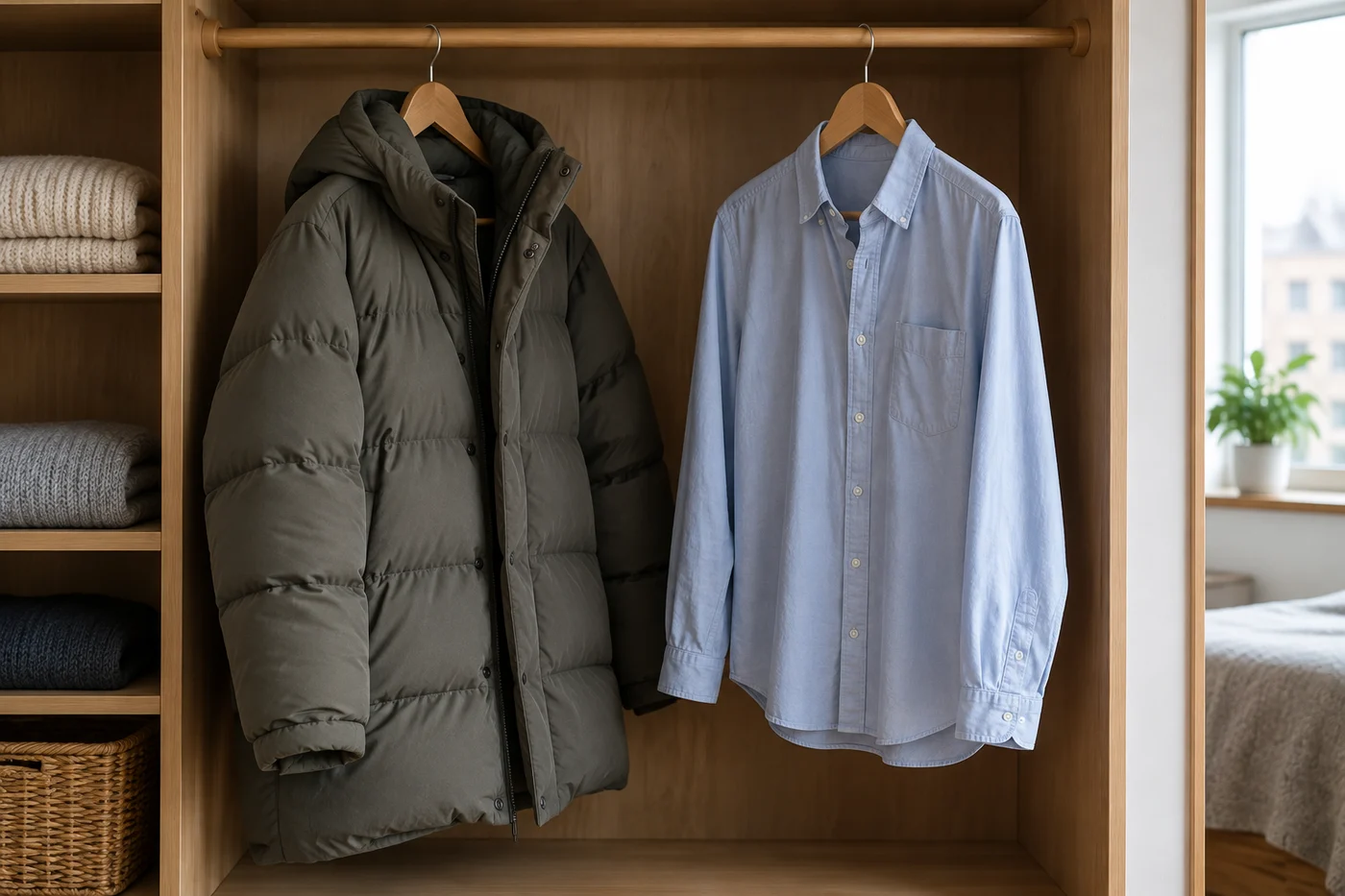
For a rail running across the closet width, hangers normally sit perpendicular to that rail. Their shoulders and the clothing around them occupy closet depth. Bulky garments may extend beyond the empty hanger, and sleeves or a hood may contact a surface unexpectedly.
Use more than one representative item. A thin shirt fitting does not confirm that a padded coat or structured jacket will. Include clothing from the season you need the closet to serve, particularly if the closet is also used for outerwear.
Close the door carefully with representative garments hanging in position. Check for contact without forcing it. Open and retrieve a garment, then return it. Assess whether clothing catches at the opening or presses against neighboring items.
If you are assessing a proposed layout rather than a built closet, use the dimensions of your real clothing in the discussion. A designer’s drawing of an empty hanger cannot replace that information. Any paper mock-up is a planning aid, not a verified installation result.
Check rail position and vertical clearance too
A rod’s location determines how hanging clothes divide the available depth. Moving it forward may reduce back-wall contact while bringing garments closer to the door. Moving it backward can have the opposite effect. Evaluate both sides rather than solving one collision by creating another.
Do not move an installed rail without checking its system instructions, mounting requirements and rental permission. Follow the manufacturer specifications for supports and loads. This article does not give a universal rod-offset dimension or installation method.
Depth is also separate from hanging height. Measure from the hook to the hem of your longest garment. Check shelves, drawers, a second rail and floor storage below it. A closet can be deep enough while still too short for the clothes you want to hang.
ClosetMaid’s planning guidance uses garment lengths and room dimensions and calls for adequate drawer clearance. Evaluate each part of your actual arrangement rather than applying an example height to every closet.
Account for the door system
With hinged doors, check hinge projections and the space the door needs to open. Consider whether you can reach the outer sections and whether any added organizer occupies the same area as clothing.
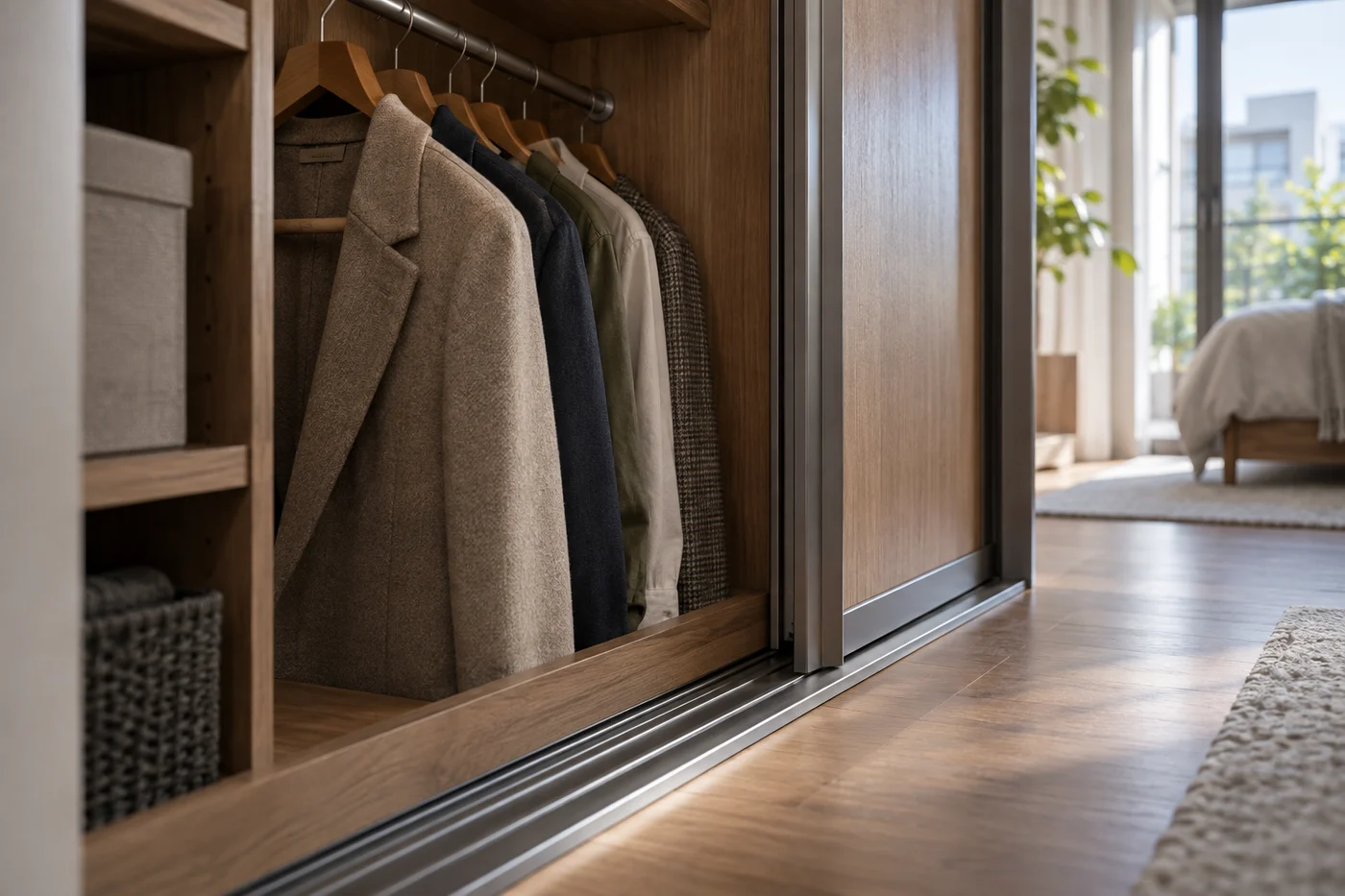
Sliding doors can leave only part of the opening accessible at a time. Measure to the actual interior door plane and account for tracks or overlapping panels. A drawer may fit inside the closet but still be unable to open through the available doorway.
Bifold doors also have a folding path and hardware. Check them in both open and closed positions. Keep garments and containers out of their movement rather than assuming the closed front edge describes every obstruction.
Do not force a door closed against clothing to make a marginal layout seem usable. If contact persists, change the allocation, hanging orientation or storage method. Door removal or replacement may require permission and a separate design decision.
Adapt a shallow closet without pretending it is deeper
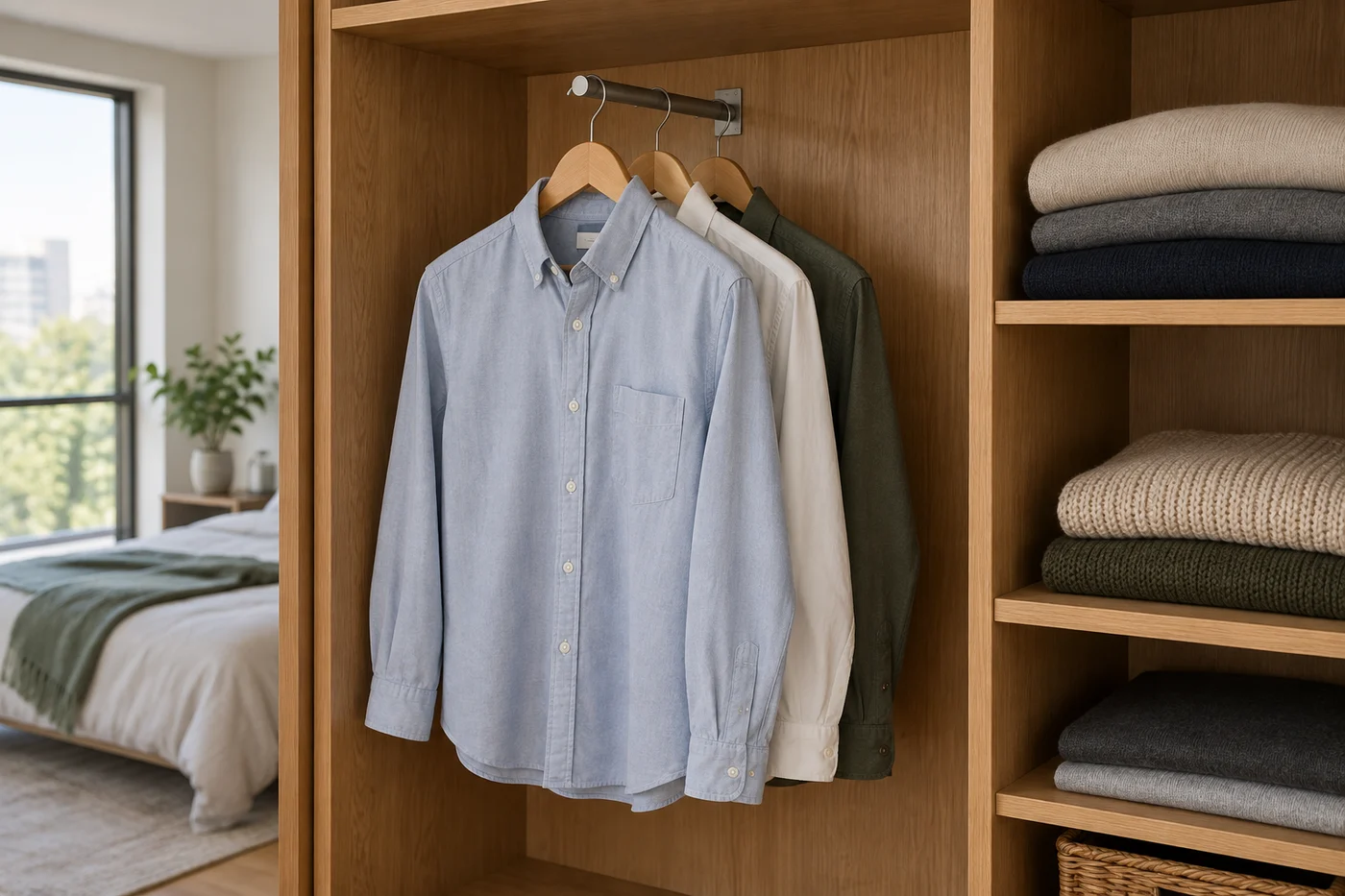
A shallow space may suit folded clothes, accessories or a manufacturer-designed front-to-back hanging arrangement. In that arrangement, garments face toward the opening rather than presenting their shoulders across the closet depth. Access and capacity differ from a conventional rail.
For example, IKEA describes a KOMPLEMENT rod designed for forward-facing clothes in a shallow 13 3/4-inch PAX frame. This is a specific compatible system. It does not mean any ordinary rail can be rotated inside any shallow closet, or that your garments will have the same fit.
Check the exact accessory, matching frame, intended load and retrieval method. If an alternative rail pulls out, include the space needed in front of the closet. If it is fixed, consider whether reaching a rear garment requires removing the clothes in front.
You can also allocate shallow shelves to suitable folded clothing and hang selected garments elsewhere. Choose a deliberate overflow location rather than crowding the doorway. Avoid cutting or modifying a manufacturer system without the appropriate instructions and expertise.
Make the fit decision from complete use
Record clear depth, relevant hardware, hanger and garment envelope, rail location, hanging height and opening access. Then assess the clothes the space actually needs to serve.
A closet that accepts one empty hanger is not a confirmed wardrobe solution. A workable arrangement lets you close the door normally, retrieve the clothing you need and return it without forcing or rearranging neighboring items.
Start with the 24-inch conventional reference, then measure your actual enclosure and representative clothes. Where they do not fit, choose an arrangement designed for the shallow space or give those garments another suitable home.