
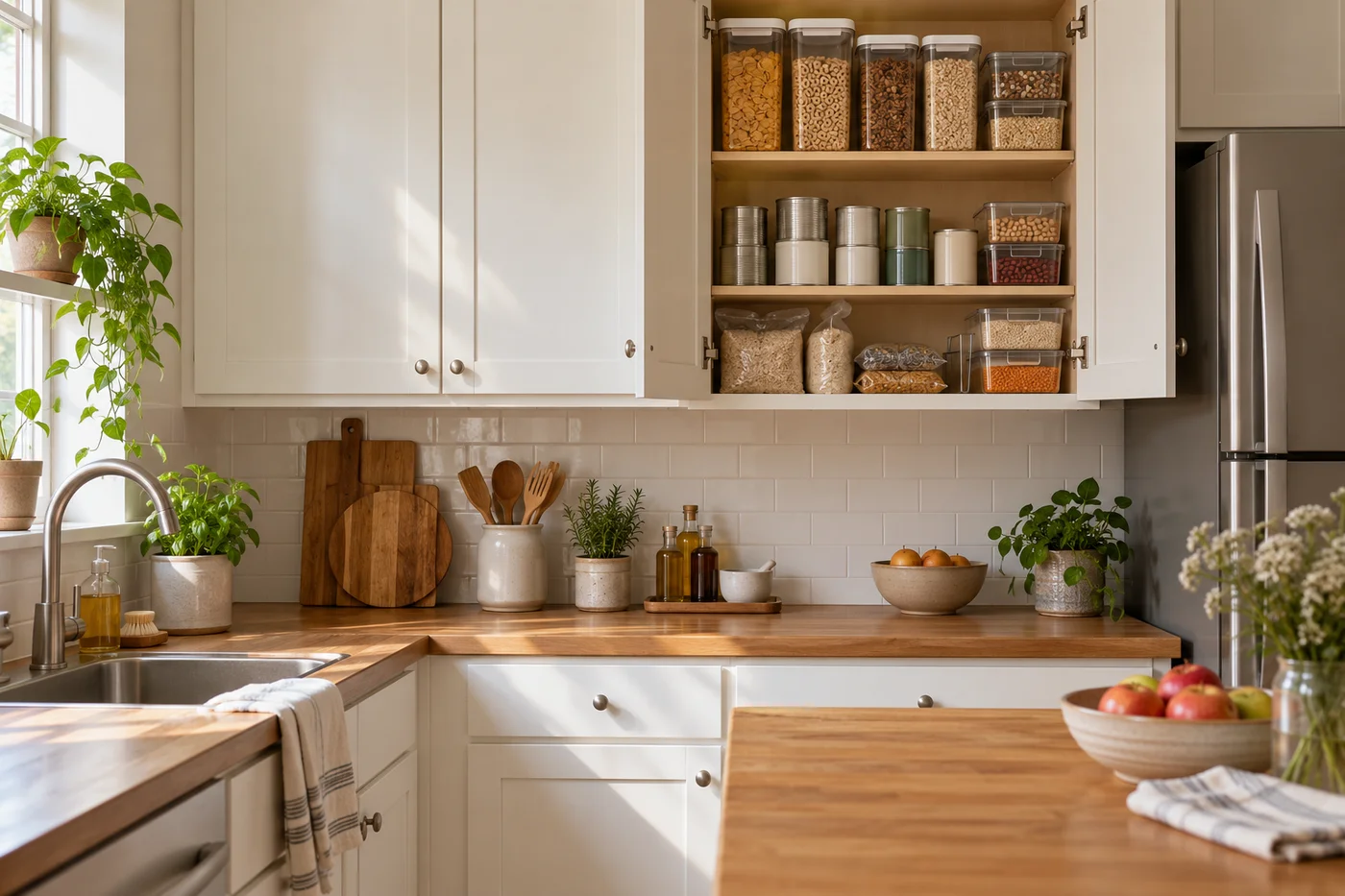
You do not need a dedicated pantry to keep shelf-stable food organized. You need one clear food system: a small number of zones, a place for daily items, and a separate place for backup items. Start with the cabinets, drawers, or shelves you already have. Add another piece only when food still has no reachable home.
This guide is only about food. Dishes, cookware, utensils, and appliances need a different plan, covered in our guide to kitchen storage without cabinets. A food zone works best when it does not become the place where every kitchen item is hidden.
Keep the problem food-only
A pantry is a food-storage system, not a particular closet. In a small kitchen, it can be one cabinet, two nearby shelves, a drawer, or a freestanding unit that is suitable for your room. The useful question is not “Where can I fit more stuff?” It is “Where can I find, use, and put back the food I actually keep?”
Begin with shelf-stable food: cans, jars, dry goods, snacks, breakfast items, baking supplies, and unopened drinks if you keep them. Keep refrigerated and frozen food in the appliance that is meant for it. The FDA says to follow package storage directions and keep a refrigerator at or below 40°F (4°C) for food that needs refrigeration. Read the FDA’s food-storage guidance.
Leave pots, plates, and small appliances out of this inventory. Mixing them into the plan makes it harder to see whether you really lack food storage or simply have too many different jobs assigned to one cabinet.
Sort before you shop
Pull food from the places where it has gathered, then sort it into four simple groups. You do not need to count every cracker or create a perfect spreadsheet.
- Daily food: items you reach several times a week.
- Weekly food: ingredients you use regularly but not every day.
- Backup food: unopened extras that replace something you already use.
- Occasional food: holiday baking supplies, specialty ingredients, and items you buy rarely.
Look for duplicates as you sort. Three open bags of the same snack can make a kitchen look like it needs a larger pantry when it really needs one designated snack home. Keep only a reasonable amount of backup food for the space you have. The aim is visibility, not a display-worthy shelf.
Give each food group a zone
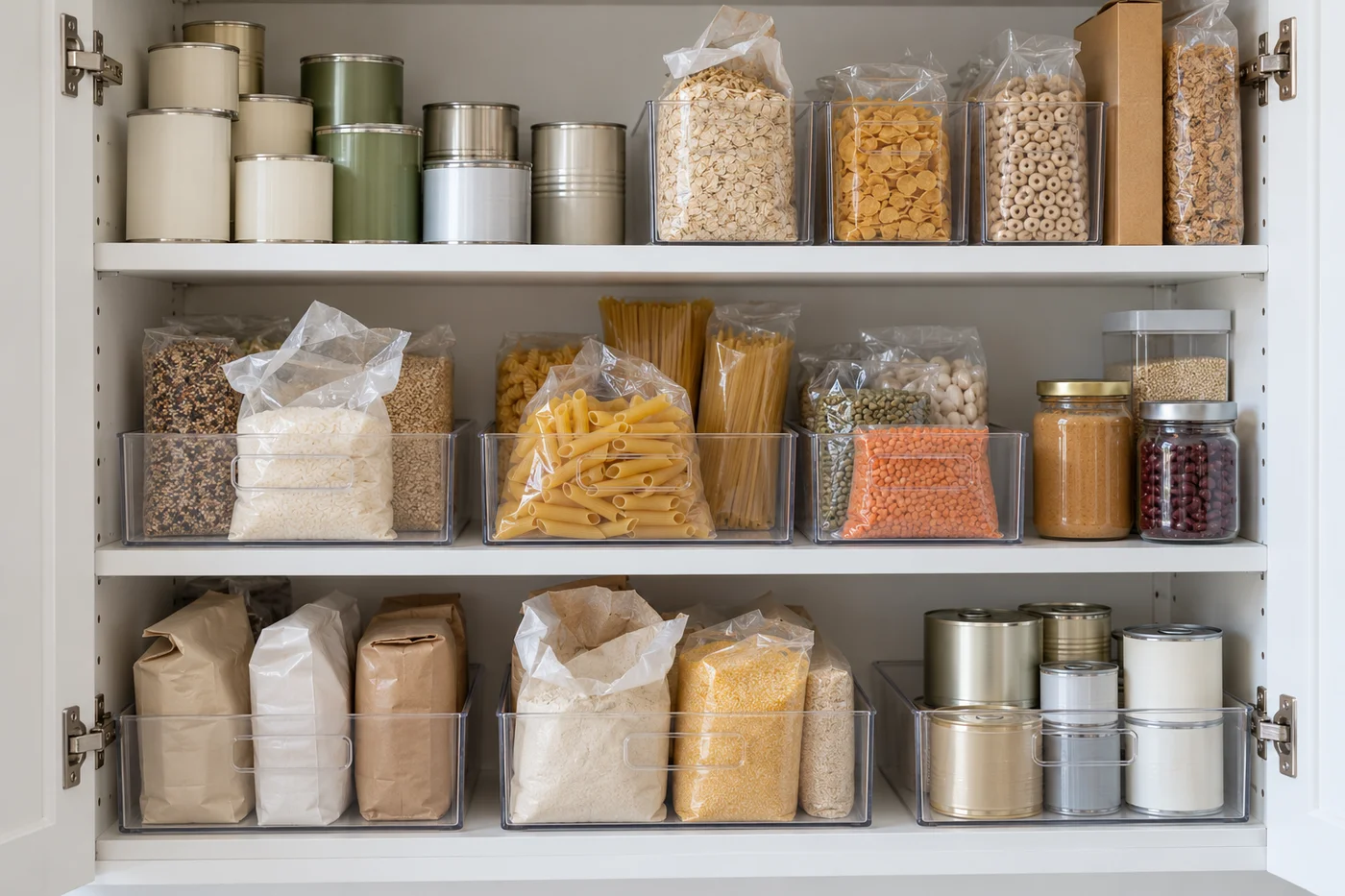
Choose zones by use, not by packaging. A breakfast zone might include cereal, oats, coffee, and shelf-stable milk if those items are part of your routine. A cooking zone might hold rice, pasta, sauces, and canned ingredients. A baking zone can be smaller and higher or farther back if you only use it sometimes.
Put daily food where you can reach it without moving another category. Keep backup food together behind, below, or beside its everyday version when that is practical. This makes it easier to see what you have before adding another package to the cart.
Use a label only when it removes a real point of confusion. A simple label such as “breakfast” or “baking” is enough. Avoid creating a container for every single food type. Too many tiny categories make a small system harder to return to after a busy week.
Use the current kitchen first
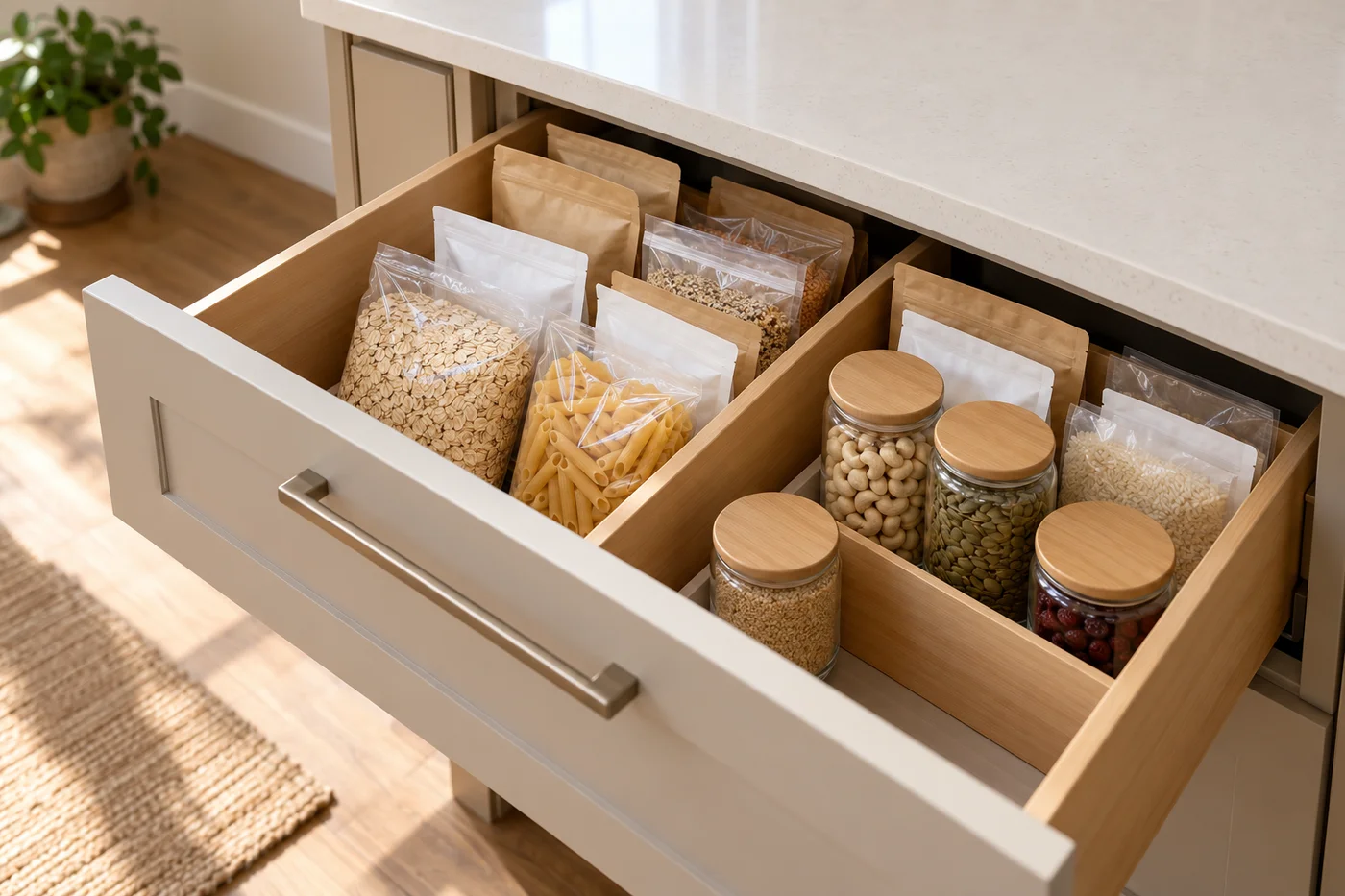
Before buying bins, shelves, or a cart, test a no-purchase version. Empty one cabinet or shelf that is currently doing several unrelated jobs. Move cookware, dishes, and tools to their proper homes, then assign the cleared space to food. If a drawer works better for snacks or packets, use that instead.
Try the new zones for several days. Notice what lands on the counter, what requires kneeling each morning, and what gets forgotten. That is useful information. It tells you which group needs to move closer, not necessarily which product you need to buy.
For a cabinet zone, check that doors and drawers can still close without forcing them. Make room to wipe the shelf and see the back row. Do not stack food so high that a package falls when you open the door. Your own cabinet dimensions, hinges, and shelf position decide what fits, so do not rely on a styled photo or a product listing as proof for your kitchen.
Add a pantry alternative carefully
If the current kitchen still leaves food homeless, choose one added zone based on the category that remains. A small open shelf may make sense for food that is easy to reach and you are comfortable seeing. Closed storage can reduce visual clutter for backup food. A movable cart can be useful only if it has a stable parking place and you can still use the kitchen normally.
Mark the possible footprint on the floor with paper or painter’s tape. Open nearby doors and drawers, walk the route to the sink and refrigerator, and check cleaning access. If the outline makes the kitchen harder to use, it is not a good location.
Tall or top-heavy storage needs special attention. The CPSC’s Anchor It! campaign says that anchoring furniture with drawers, doors, and shelves to the wall helps prevent tip-over injuries. Follow the maker’s instructions for the specific unit, hardware, wall type, and contents. Check your lease before making any wall change.
An over-door organizer is not an automatic pantry solution. It only works if you have a suitable door, clearance at the top and bottom, and installation instructions that match the actual door. Do not assume that a door will close properly or carry a loaded organizer without checking its documentation.
Store food with safety in mind
Keep food storage away from household cleaning products and chemicals. The FDA specifically advises keeping nonperishable food away from poisons. Read storage directions on each package, especially for items that may look shelf-stable but require refrigeration after opening.
Keep food and anything that can catch fire away from the stovetop. The National Fire Protection Association says to keep combustible items such as packaging, towels, oven mitts, and wooden utensils away from the stovetop. That is a safety boundary, not a universal distance rule. See the NFPA cooking-safety sheet and follow appliance instructions for your kitchen.
Check cans and packages as you put them away. The FDA says damaged cans can include swelling, leaking, punctures, holes, severe rust, or damage that prevents normal stacking or opening. Do not build a storage system around food that should be discarded or returned.
Reset the system
Pick a short weekly reset: return food to its zone, combine open packages where appropriate, wipe crumbs, and look for items that need to be used. A larger reset can happen before a grocery trip. Keep the goal modest. You are maintaining a system that works in a small kitchen, not trying to make every shelf look permanent.
If food is still spilling onto the counter, identify which category has no realistic home. First try moving an occasional group out of prime space. Then consider one added storage zone. For a broader set of room-by-room ideas, visit Storage Ideas.
Frequently asked questions
How do you organize a small kitchen without a pantry?
Sort shelf-stable food into daily, weekly, backup, and occasional groups. Give daily food the easiest-to-reach zone, keep backups together, and test existing cabinets or drawers before buying storage.
What can you use instead of a pantry?
A cabinet, drawer, shelf, or freestanding storage area can act as a pantry alternative when it gives food a stable, reachable home. Check door swing, walkways, cleaning access, and any anchoring instructions before adding furniture.
Can food be stored near the stove?
Keep food packaging and other combustible items away from the stovetop. The NFPA advises keeping items that can catch fire away from it. Follow your appliance instructions and use a different food zone if heat or cooking activity reaches that area.
Keep the next change small
An effective no-pantry kitchen is usually a few clear zones, not a wall of containers. Start with the food you use, test the arrangement, and add only what solves a specific gap. That approach keeps food easier to find and leaves the rest of your kitchen available for cooking.