
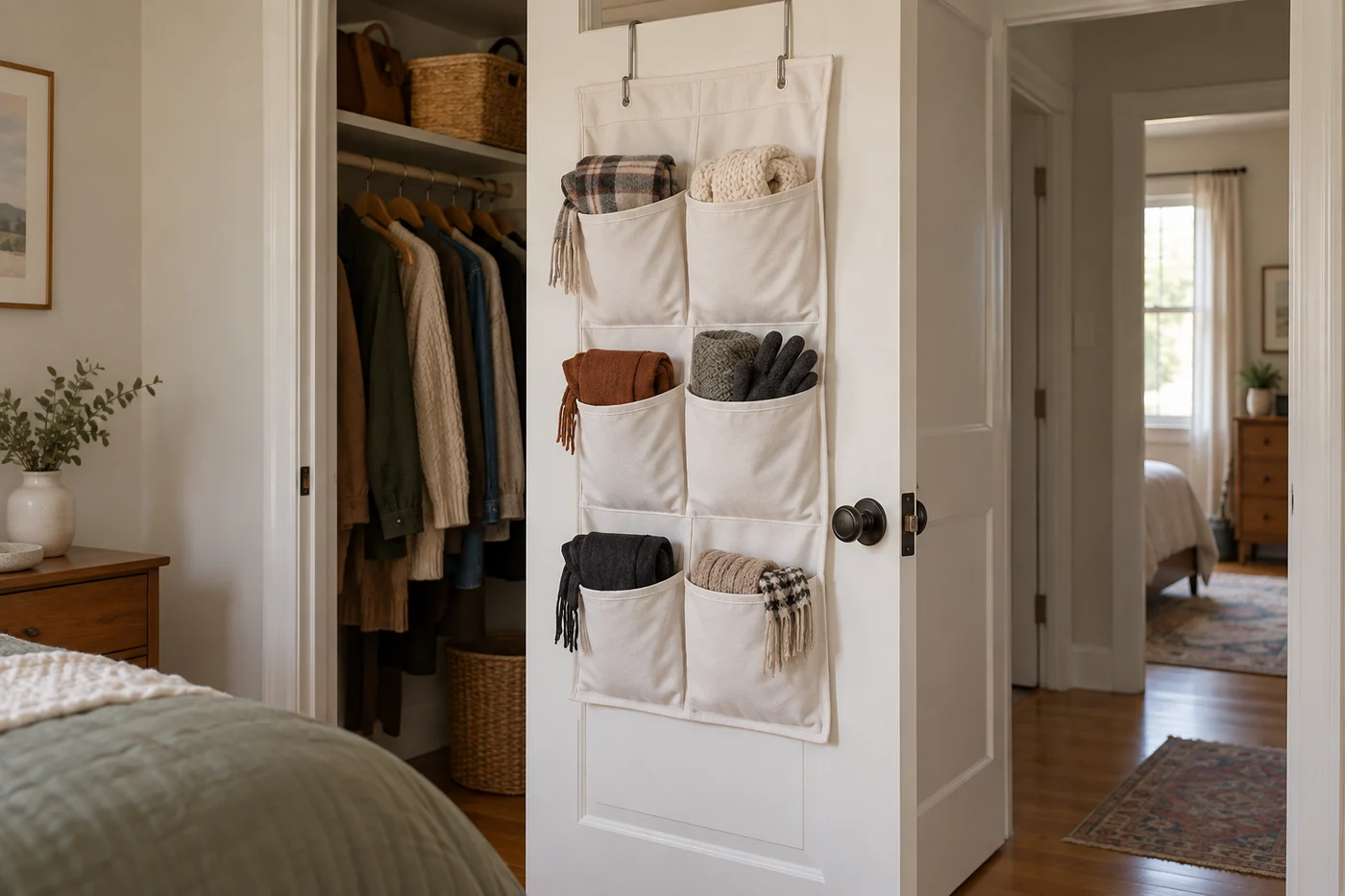
Good over the door storage ideas assign a small, clear group of belongings to a door that can still open and close normally. A pocket organizer can group scarves, gloves, fabric totes, or light craft supplies. It should not become an extra closet full of unrelated items or prevent a door from latching.
Start with the organizer you own, or with the specifications for the exact one you are considering. This is a guide to arranging belongings and checking fit, not a list of best products. The door’s thickness, top clearance, movement, and permitted attachments decide whether the idea works.
Check the door before filling the organizer
Identify the door and its role. An ordinary interior closet door is different from a sliding door, bifold door, exterior door, or door that must meet particular fire or ventilation requirements. Do not modify a required door function for storage.
Read the organizer’s instructions. Confirm door compatibility, hanger dimensions, attachment requirements, and capacity. Some organizers use over-door hooks; others require a lower stabilizing fixing or a wall mount. Do not omit a required part to describe the installation as no-drill.
Measure door thickness and the available gap at the top. Check that the bracket shape suits the door, not merely that it can be pushed over its edge. The door should still close and latch without force.
Look at the wall behind the open door. A loaded pocket can project beyond the organizer’s empty depth and collide with the wall, trim, or furniture. Check the path slowly with the door open and closed.
If the organizer rubs, catches, or prevents normal closure, remove it and choose another location. Do not trim a door or alter a hinge as an organizer workaround.
Pick one clear job for the pockets
Choose a category you frequently need and can recognize at a glance. Useful candidates include cold-weather accessories, lightweight fabric bags, small craft-paper supplies, or a few frequently used soft accessories.
Avoid starting with everything that does not fit elsewhere. Mixed pockets filled with shoes, chargers, cleaning products, receipts, and cosmetics are harder to maintain because each item belongs to a different routine.
Place the intended items on a table and divide them into groups. For gloves and hats, group by person or by item type. For craft materials, group by project or function. Choose the method that makes it easiest for your household to find and return things.
Keep the group smaller than the organizer’s visible pocket count. Empty pockets are useful when you need to return an item quickly or add a temporary accessory. Filling every opening is not a measure of successful organization.
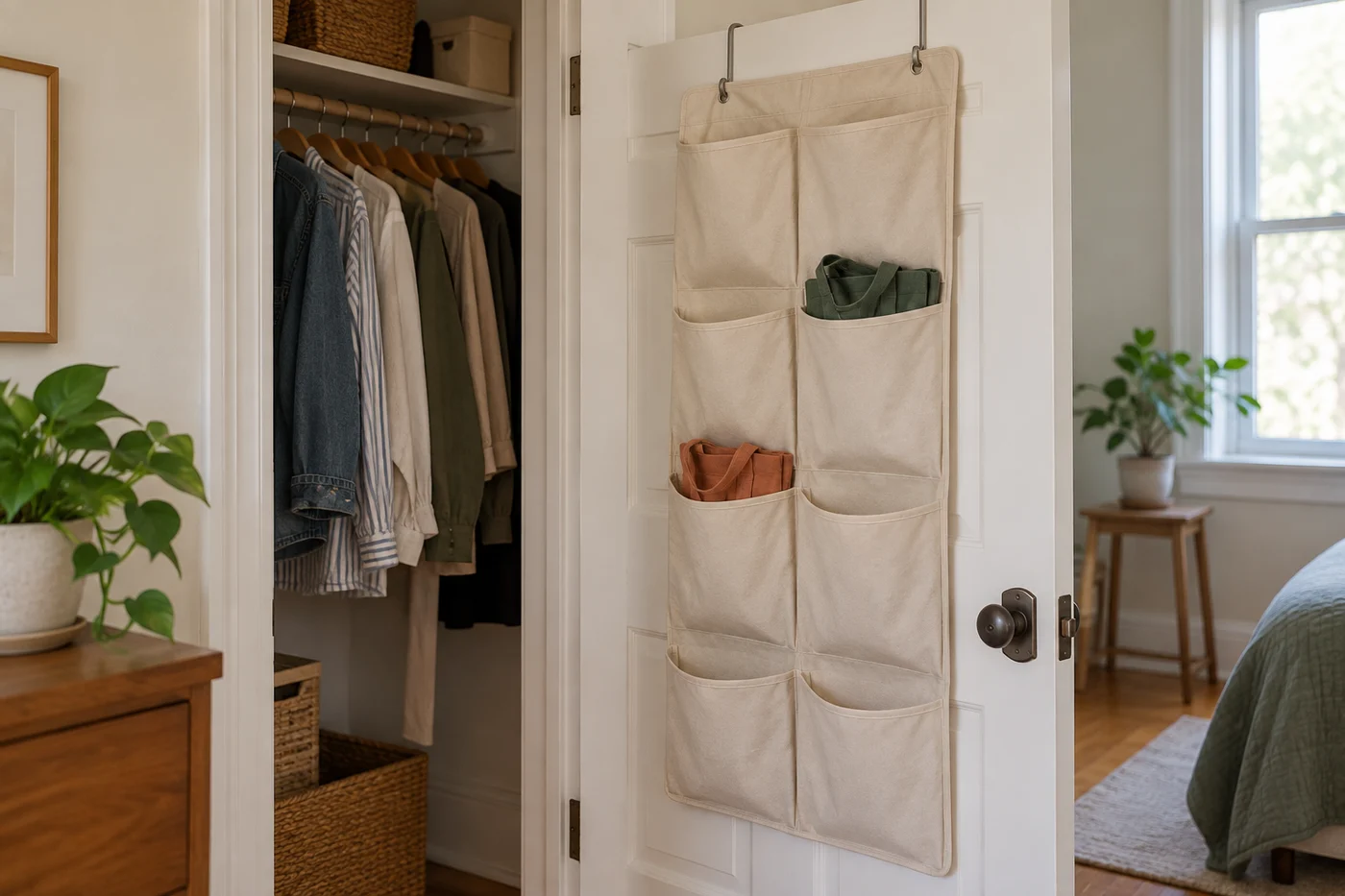
Arrange soft accessories by reach
Scarves, gloves, hats, and small fabric totes can suit pockets when the organizer’s intended use and capacity allow them.
Place the items used most often within comfortable reach. Put occasional soft accessories in the less convenient pockets. Avoid overstuffing one pocket with several categories, especially where the bottom of a scarf hides smaller gloves.
Check whether the pocket lets you remove an item without pulling the whole organizer. A tightly wedged tote or a pocket stretched around a bulky hat may make the task awkward even when everything technically fits.
If several people share the organizer, a simple grouping can help. Assign one row or a few adjacent pockets to each person rather than mixing all the belongings and relying on memory. Keep any labels short and easy to change.
For overflow coats or large bags, use a different suitable storage area. One light pocket organizer does not replace a verified coat rack or a closet rail.
Make a small craft or desk-supply zone
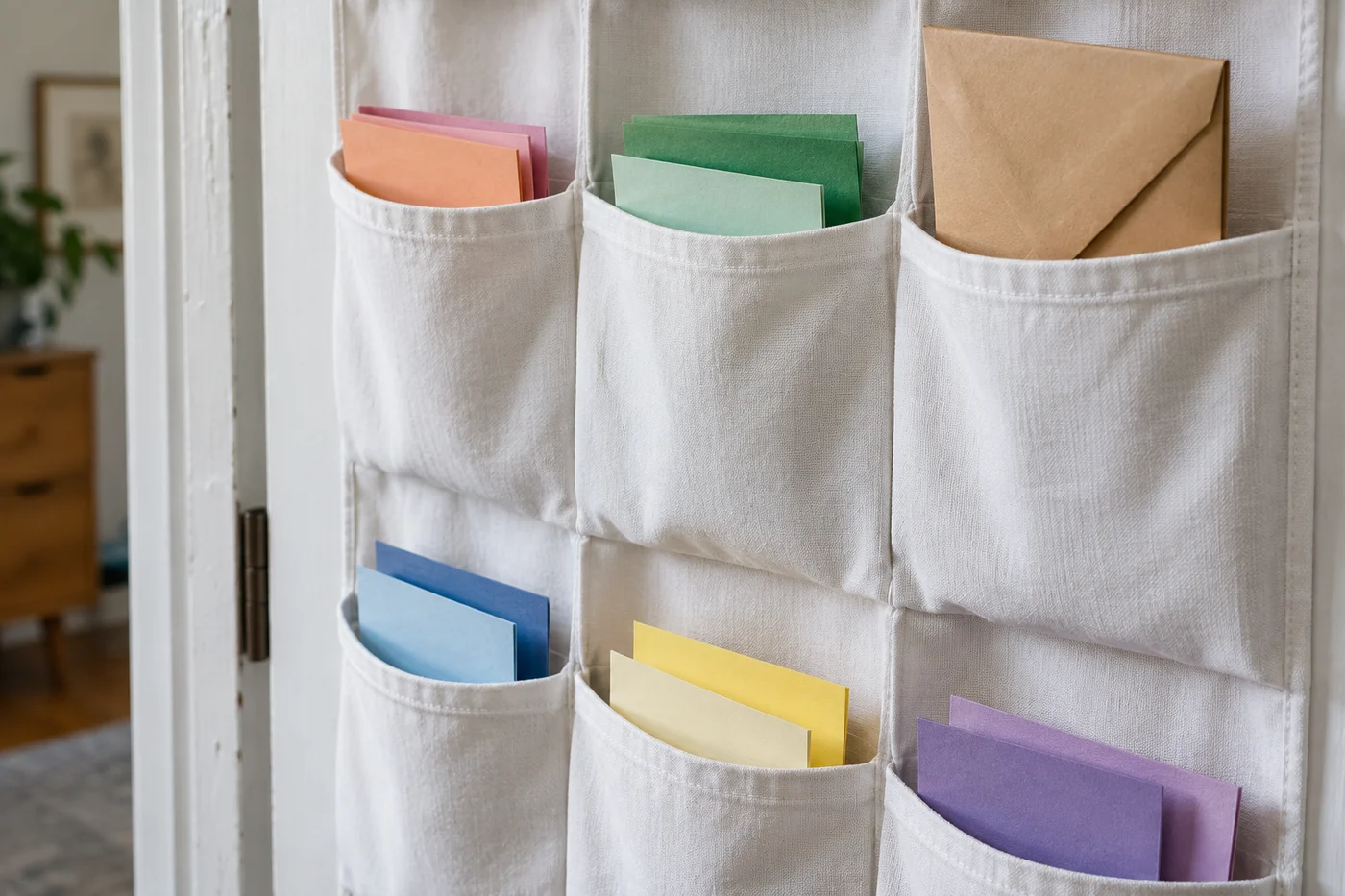
A pocket organizer can group suitable light supplies when the door is near the place you use them. Paper pieces, small fabric materials, and lightweight accessories may be easier to locate in separate groups than in a deep mixed drawer.
Check the pocket shape against the actual item. A shallow pocket might reveal a paper pack while a deep one hides it. Leave enough room to grasp the item without pulling hard on the fabric.
Keep sharp items and hazardous materials in suitable secure storage, following their labels and the needs of your household. An accessible pocket is not automatically a safe location for every tool or craft product.
For desk supplies, keep cords separate from items that can catch them. Do not route charging cables across a moving door or use the organizer as a place to operate electrical equipment. USFA’s electrical safety guidance advises avoiding cord locations where they can be pinched or damaged.
Give unfinished projects a defined limit. If a project needs more space than its assigned group, move the complete project to a suitable container rather than distributing it across unrelated pockets.
Treat bathroom and laundry storage more carefully
Light dry accessories may suit a bathroom door when the organizer is intended for the conditions and the door still works. Check moisture suitability and keep contents dry according to their care instructions.
Do not use open pockets as a default medicine or chemical cabinet. Those products may need temperature, moisture, original packaging, or secure-storage conditions that the organizer cannot provide. Follow the label and keep hazardous products appropriately secured.
Laundry packets are a clear example. CPSC advises keeping them sealed in their original packaging, locked up and out of children’s sight and reach. Putting individual packets in a high pocket is not the same as locked storage.
A laundry closet door may also provide required ventilation. Do not cover openings with the organizer or its contents. Read the appliance installation instructions before treating the inside of that door as spare space.
If the conditions are unsuitable, move the soft accessories to a bedroom closet door and use an appropriate cabinet for bathroom or laundry products.
Load according to the exact instructions
Check whether the manufacturer’s stated capacity is for the entire organizer, an individual hook, a pocket, or a specific installation method. If that distinction is unclear, ask the manufacturer rather than multiplying a number by the number of openings.
For example, Umbra’s Estique product documentation specifies compatibility and loading for its own hook system. Those specifications do not establish capacity for a fabric pocket organizer of a different design. The current page also contains differing door-thickness descriptions, so verify the instructions for the exact model instead of relying on an ambiguous listing.
Begin with the intended group, within the verified capacity, and check door movement again. A loaded organizer can sit differently from an empty one. Look for contact with the door frame, wall, shelf contents, and the floor.
Keep heavy or breakable belongings in another appropriate storage area if the system does not clearly support them. Do not use a short successful hanging period as proof of capacity or long-term stability.
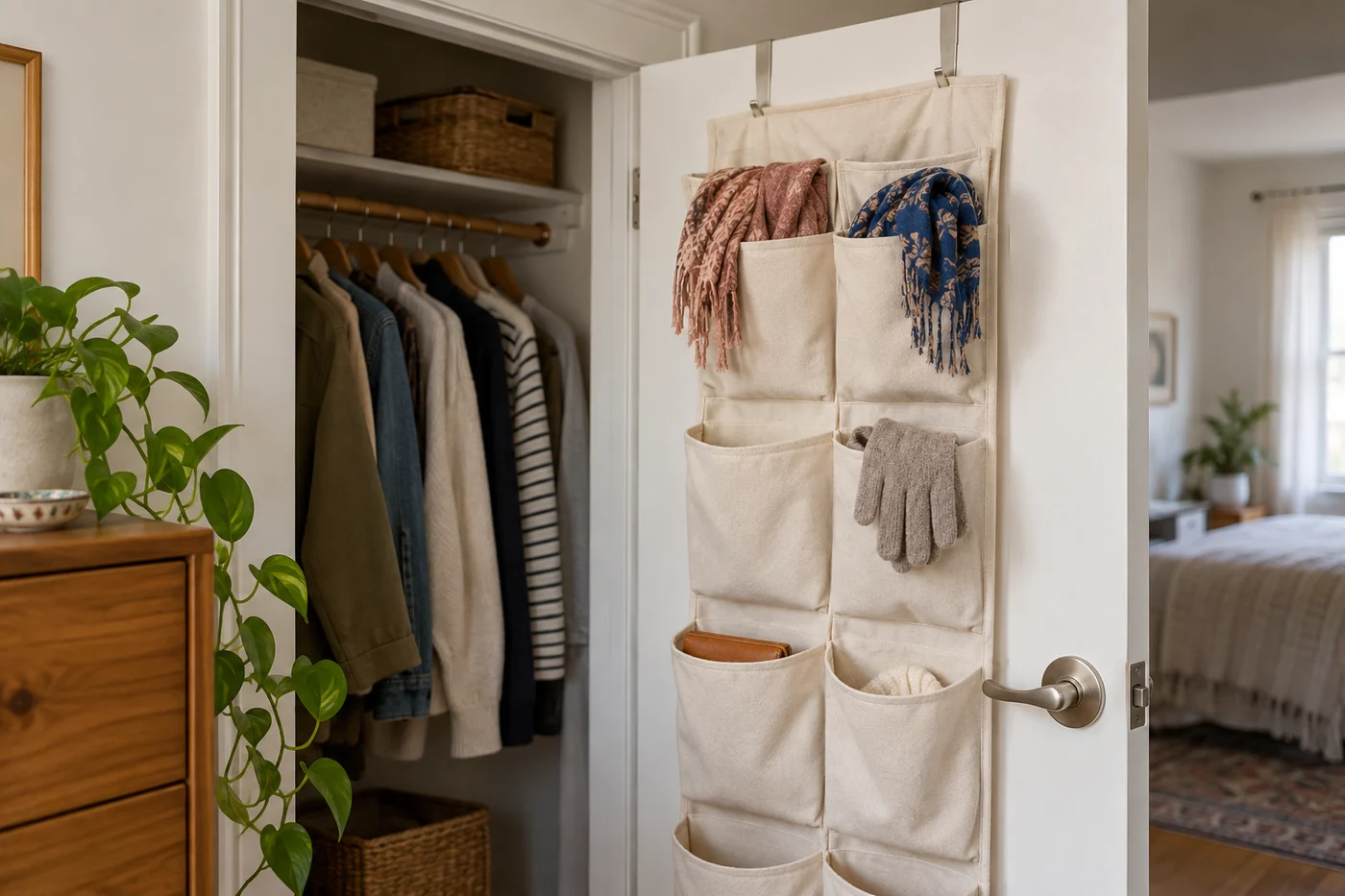
Keep the system easy to reset
Use the organizer through a normal week. Are belongings returning to their pockets? Is one pocket accumulating unrelated objects? Do you leave the door open because closing it is difficult?
If an item repeatedly lands elsewhere, move its pocket closer to the point of use or choose another storage location. If a pocket catches against a shelf when the door closes, empty that pocket and reassess the depth before adding more.
Remove everything periodically so you can inspect and clean the organizer according to its care instructions. Check brackets and contact points for movement or damage. Keep the original installation guidance for future adjustments.
The organizer succeeds when it gives a particular routine a clear place while preserving the door’s normal function. For belongings that need a larger clothing arrangement, use the clothes storage without a closet guide.
Common questions
Can every door take an over-door organizer?
No. Door style, thickness, top clearance, required functions, and the organizer’s instructions determine compatibility. Remove any arrangement that prevents normal closure or latching.
Should you put the heaviest items in the bottom pockets?
Placement alone does not establish a safe load. Follow the exact system’s load and distribution instructions, and move unsuitable heavy contents to supported storage elsewhere.