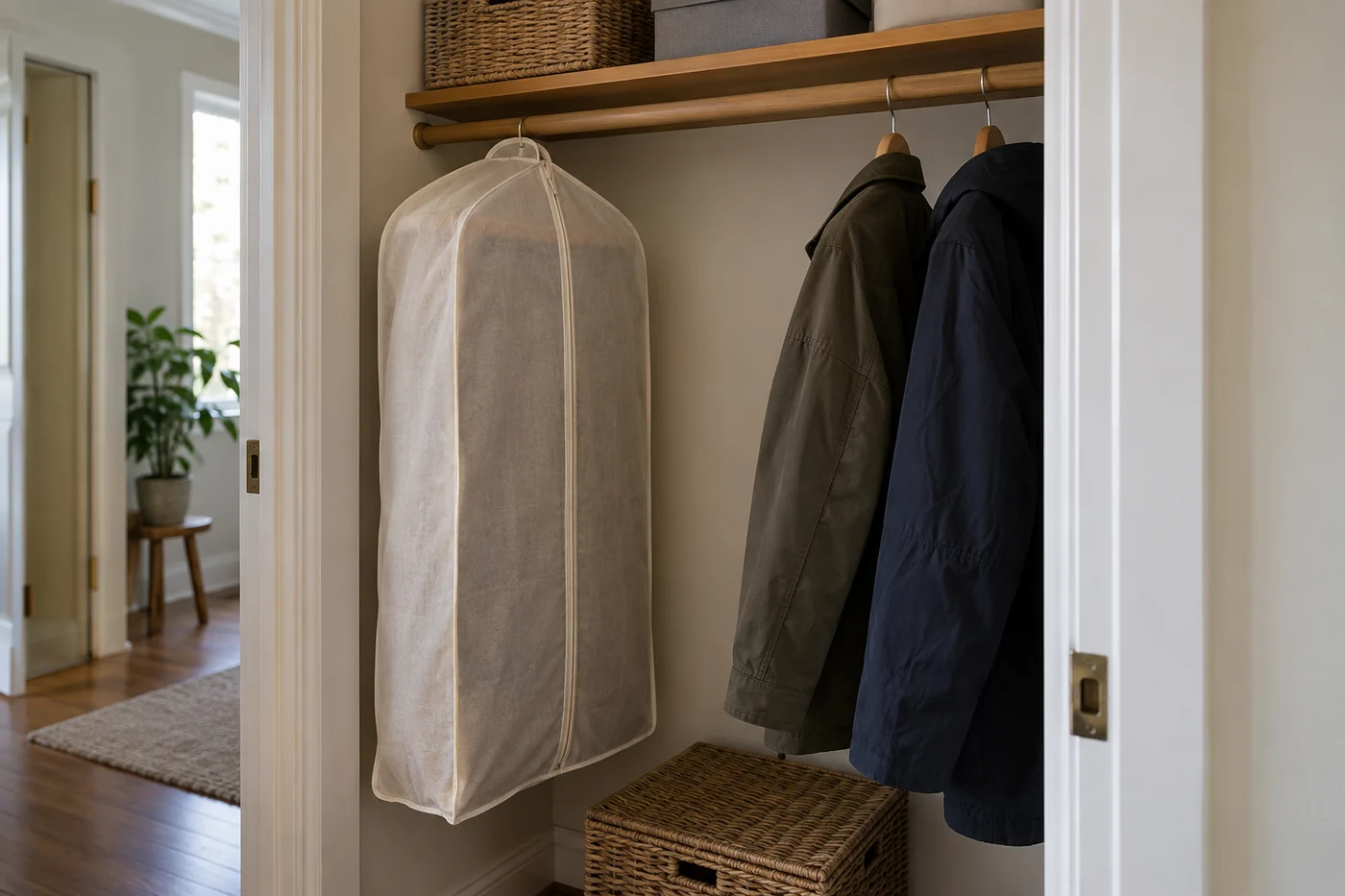
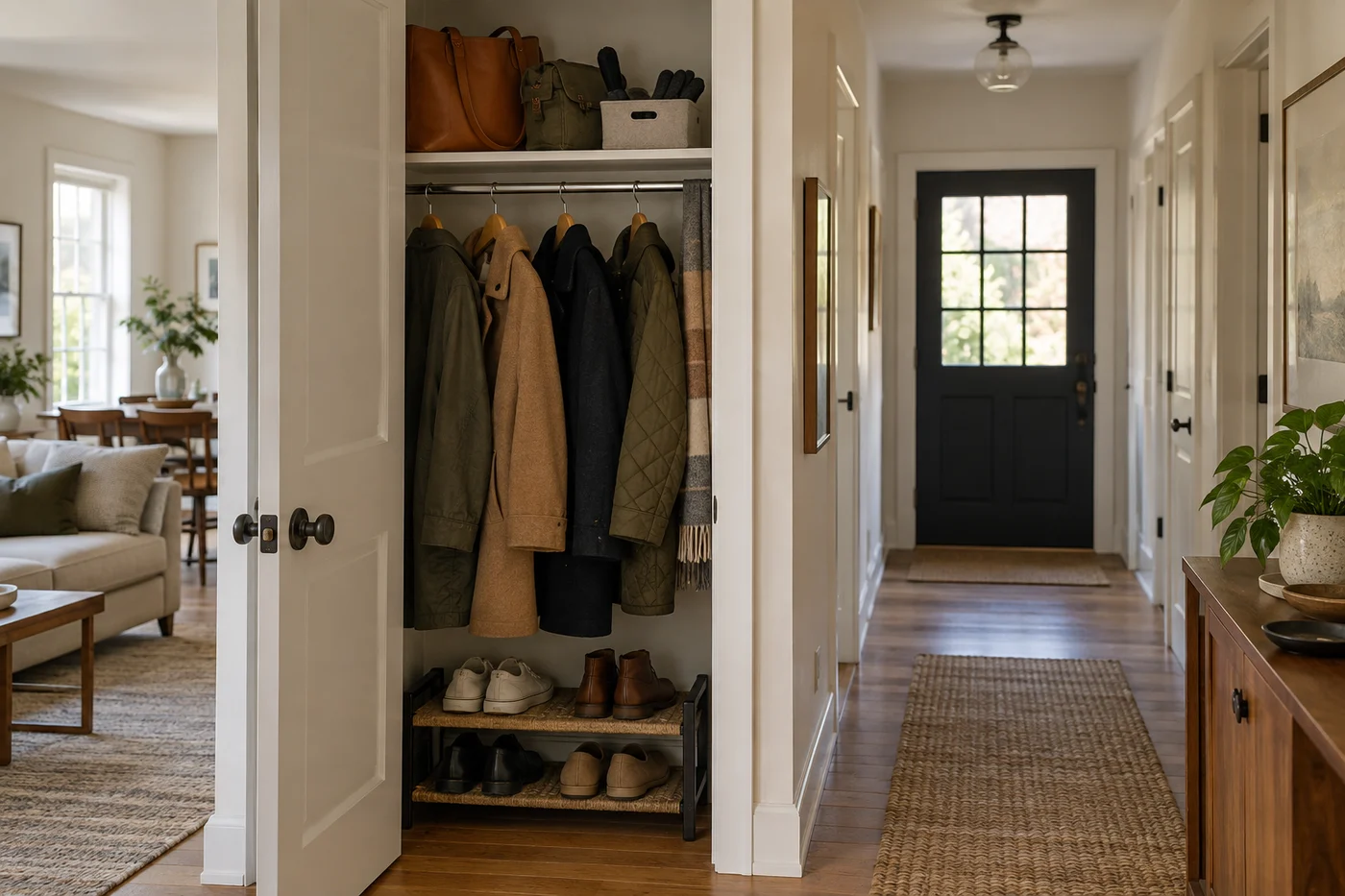
Small hall closet organization ideas should start with the closet’s everyday job. Decide which current coats, bags, shoes and household items need to live here, then give them reachable zones. Keep long coat hems clear, use the door only when it closes properly, and move reserve belongings out of the easiest-to-access space.
A hall closet often becomes the home for anything that has no obvious destination. You can make it useful again without pretending it has unlimited capacity. Separate daily departure gear from seasonal reserves and household supplies before choosing organizers.
Keep the closet’s role connected to the entryway arrival routine so current coats and bags have a home without crowding the doorway.
Decide what the closet is responsible for
List the items you reach for here during a normal week. Coats, school bags, a leash and umbrellas may need convenient access. Spare bedding, occasional luggage and repair supplies might be better in another suitable location.
Choose a primary job, such as current outerwear and departure gear. Add secondary tasks only when the space can handle them. A small closet used for coats and a vacuum has less room for shoes than a closet used only for clothing, even if the overall dimensions are identical.
Group items temporarily outside the closet while keeping the hallway clear. Set aside belongings with another home, things to repair and anything you no longer want. Work a section at a time if a full reset would block your apartment.
For a shared household, ask which gear needs immediate access. Give those items priority without assuming everyone uses the same coat or bag routine. A useful arrangement should let each person leave without unpacking another person’s belongings.
Measure the opening and the contents
Record usable internal width, depth and height. Include shelves, supports, hinges and the door frame. Check how far the door opens and whether you can reach the far corners without leaning around its edge.
Hang your longest current coat and assess its length and bulk. A storage bin underneath needs to stay clear of the hem. A row that holds thin jackets may become crowded when winter coats return, so plan for the current season rather than relying on a summer photograph.
ClosetMaid’s planning guidance accounts for closet dimensions, garment lengths and opening clearance. Use those checks on the existing hall closet; example shelf heights do not automatically suit your coats or reach.
Measure bulky equipment too. The vacuum’s handle, attachments and retrieval angle can matter more than its base width. Check whether you can take it out without removing every coat. A closet that accepts an item only after careful rearranging may not be a good everyday home for it.
Assign zones by the way you use the closet
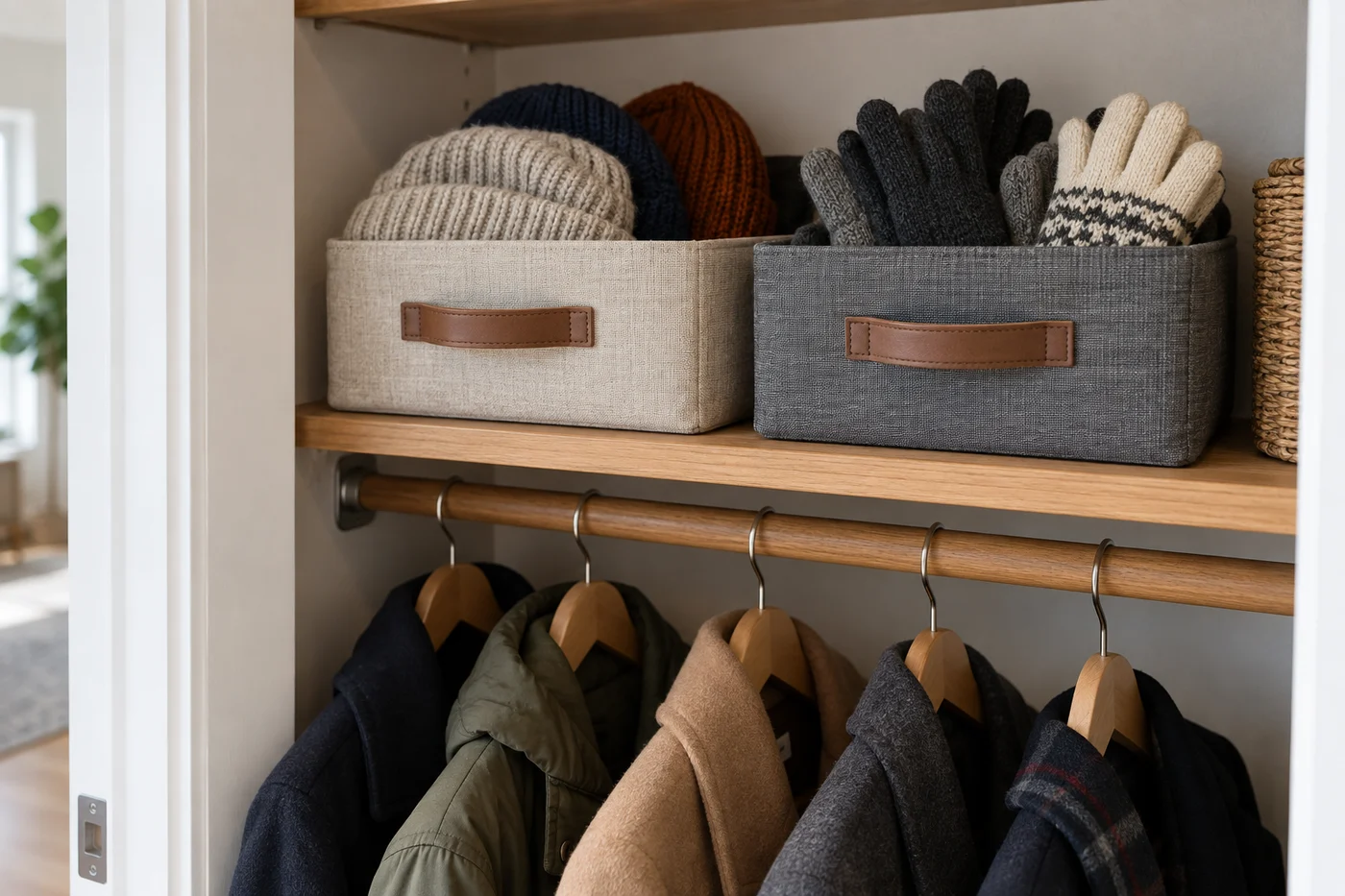
Give daily outerwear the most convenient rail section. Keep a small group of currently needed bags near its owner’s reach. Use an existing shelf for identifiable hats, gloves or other accessories that belong with that departure routine.
Put occasional reserves in locations that are less convenient but still manageable. Avoid a heavy full container on a shelf you can only reach while stretching. Its contents may deserve a lower location or another storage spot entirely.
Leave floor space for the tasks you have chosen, such as a shoe tray or upright equipment. Do not allocate it to several categories at once. If a coat hem reaches the floor zone, preserve that hanging area and put shoes elsewhere.
| Zone | Possible contents | What to check |
|---|---|---|
| Easy-access rail | Current coats and jackets | Bulk, garment length and comfortable retrieval |
| Reachable shelf | Hats, gloves or a daily bag | Container removal and clear category |
| Low space clear of hems | Suitable footwear or equipment | Door movement and easy lifting |
| Higher reserve shelf | Manageable seasonal supplies | Safe access and supported load |
| Compatible door area | Lightweight suitable accessories | Closure, projections and load instructions |
These are planning options, not a required layout. Use only zones that work in your closet. An empty patch does not need a basket if nothing useful belongs there.
Store coats and bags without crowding each other
Keep the coats you currently wear readily available. Move off-season outerwear to a suitable reserve location when your household can do so. Follow garment care labels before cleaning, folding, covering or storing each item.
Choose hangers appropriate to the coats rather than assuming the thinnest hanger saves useful space. Heavy or shaped clothing has different needs from a light jacket. Check the rail and any add-on hanging equipment against their intended loads and installation instructions.
Bags can sit on a suitable shelf, hang from compatible hardware or have another nearby home. A fully loaded work bag is different from an empty tote. Include the actual contents when assessing a hook or organizer’s load, and avoid crowding the coat shoulders with bag straps.
If you use one bag most days, reserve a place for it rather than stacking it below a collection of occasional bags. Put travel bags and spare totes together only where they are identifiable and can be removed without pulling down the daily supply.
Make the door an optional zone
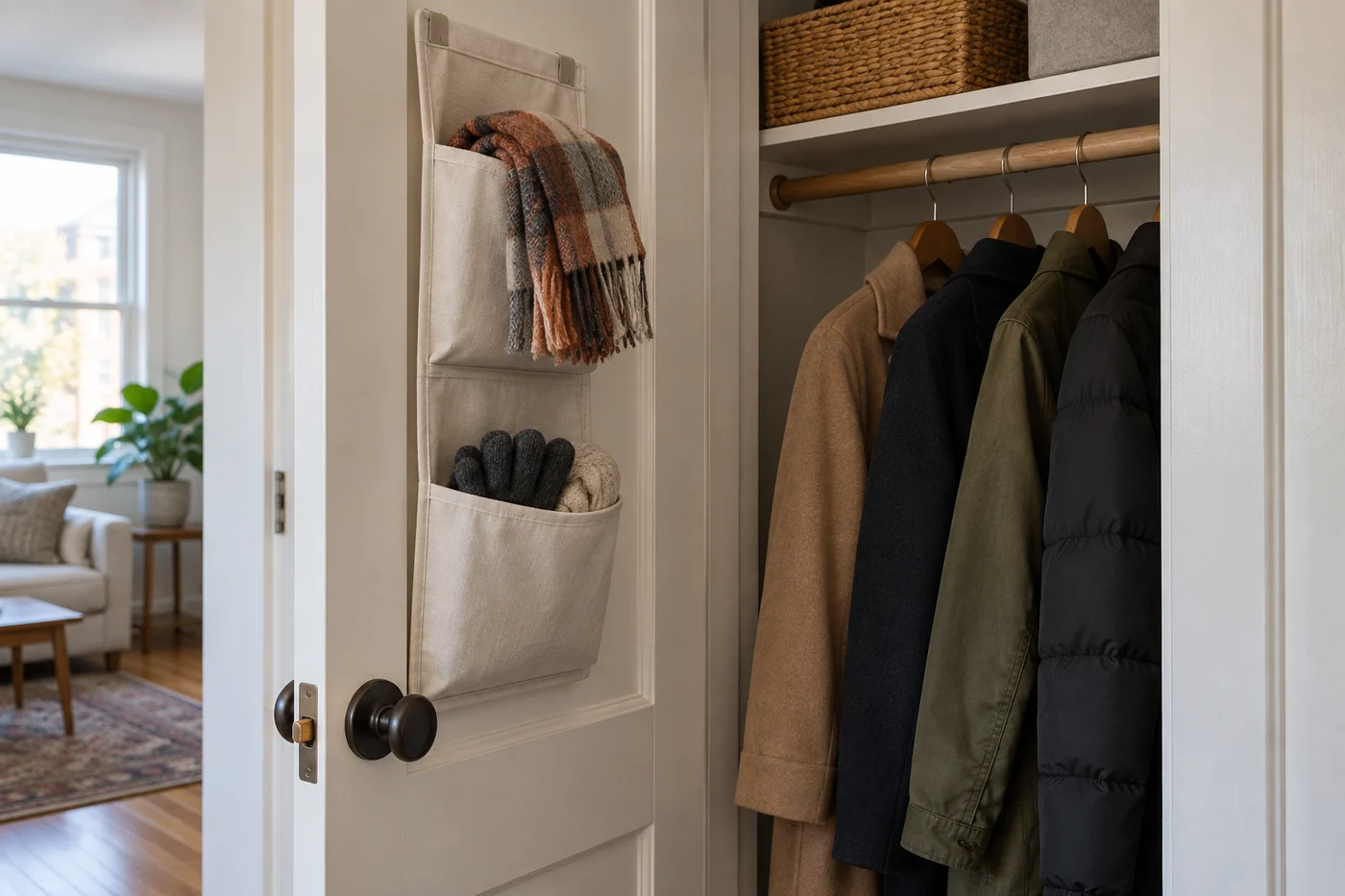
An over-door organizer may suit small accessories if the door and bracket fit. Check door thickness, top gap, bracket size and manufacturer instructions. Then assess the organizer with its intended contents, not just while empty.
Close and open the door normally. Check for contact with shelves, coats, handles or the wall. Avoid forcing a door shut or placing hard objects where normal swinging can make them strike another surface.
Keep pockets shallow enough for what they hold. A large shoe in a pocket may project farther than you expect. Put small, identifiable categories in locations you can reach rather than filling every pocket with miscellaneous objects.
If the door cannot accommodate the organizer, leave it clear. Door storage is one choice, not a requirement for a small closet. Never improvise screws, adhesive or brackets that conflict with the product’s intended installation or the lease.
Give household supplies a separate plan
If cleaning supplies must live here, keep them distinct from coats, towels and departure gear. The Virginia Poison Center recommends secure storage and original labeled containers for household cleaners. Choose a suitable secure location for children and pets, and follow each product’s storage directions.
Do not use a high shelf as a substitute for an appropriate security arrangement. Think about who can reach or climb to it, and whether moving other gear exposes the supplies. Do not transfer chemicals into decorative containers to match the closet.
Keep equipment attachments with their machine in a manageable container or permitted holder. Avoid loose parts behind the shoe tray where retrieving them requires unpacking the floor. Follow appliance instructions for storage orientation and battery charging; an enclosed hall closet is not automatically a suitable charging area.
If the primary coat-storage task and household-supply task conflict, decide which category moves. Creating another layer of organizers around incompatible uses is unlikely to make either easier to handle.
Rotate seasons without rebuilding the closet
Choose one identifiable reserve location for gear not in current use. Keep a simple note of its contents if you cannot see them. When the season changes, exchange the appropriate items rather than adding the new selection alongside the old one.
Recheck hanging bulk and floor access after the change. Umbrellas, winter boots and thicker coats can alter the usable arrangement. Keep wet-weather items in a suitable temporary drying location according to their care requirements rather than packing them immediately with dry reserves.
Try the closet during a departure and return. Can you retrieve your bag, take a coat, replace both, and close the door without shifting equipment? Check that you can also remove the vacuum or other retained household item.
Start with the current coats and daily bags. Give each a place, then add only the remaining categories the closet can serve comfortably. A hall closet is doing its job when getting ready to leave and putting things away become ordinary, manageable steps.