
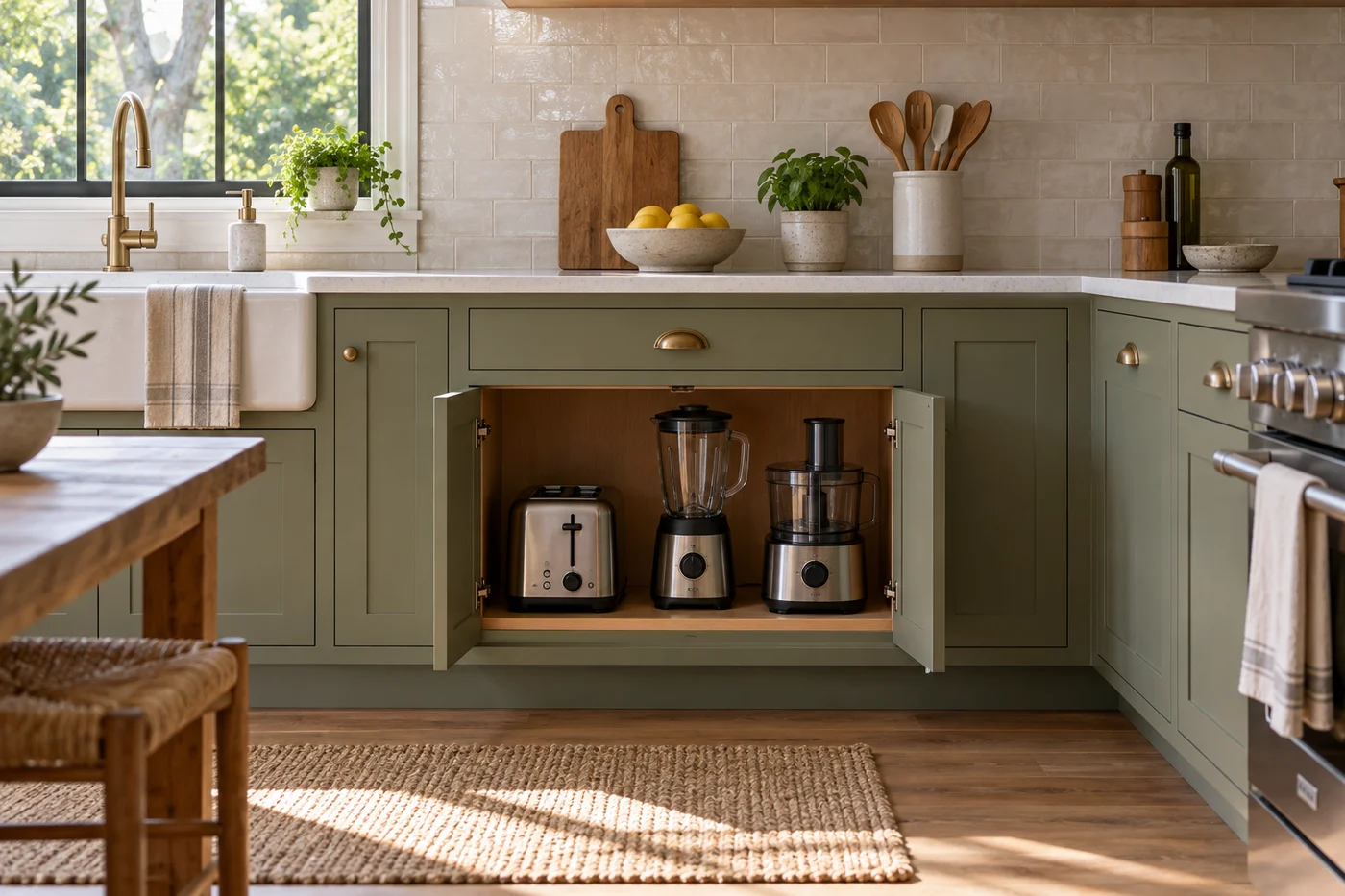
Small kitchen appliance storage ideas work when you plan three things together: where an appliance rests, how you retrieve it, and where you use it. Keep frequently used equipment accessible, put suitable occasional items away, and protect enough counter space for the cooking you actually do.
A blender fitting on a shelf does not mean you can remove its jug comfortably. An air fryer fitting inside a cupboard does not establish that it can run there. Start with the appliances you own and their instructions, then choose storage that supports the whole routine.
Appliances are one part of the kitchen. If dishes and cookware also lack homes, use the broader kitchen storage without cabinets guide alongside this plan.
Make an inventory before clearing the counter
List each appliance, how often you use it and which parts belong with it. Include bowls, blades, lids, baskets and attachments. Count the equipment needed for the task, not just the main motor unit displayed on the counter.
Group the inventory into frequent use, occasional use and items you need to reconsider. Use your real routine rather than a strict daily-versus-weekly rule. A heavy mixer used regularly may deserve an accessible place even when it is not used every morning.
Ask whether you still want the items you rarely use. You might keep a seasonal appliance intentionally, lend it through an arrangement you trust, or remove something that no longer serves your household. Do not discard useful equipment merely because it fails a minimalist counter photograph.
Check the appliance’s condition and confirm you have its model-specific instructions. Record the model number somewhere easy to find. Storage planning is easier when you can look up the real dimensions, weight, care guidance and operating requirements.
Reserve a usable preparation area
Choose the counter area where you normally prepare food. Include the cutting board, ingredients and ordinary movement between sink, stove and refrigerator. Avoid assigning all the open counter to appliance display before deciding where cooking happens.
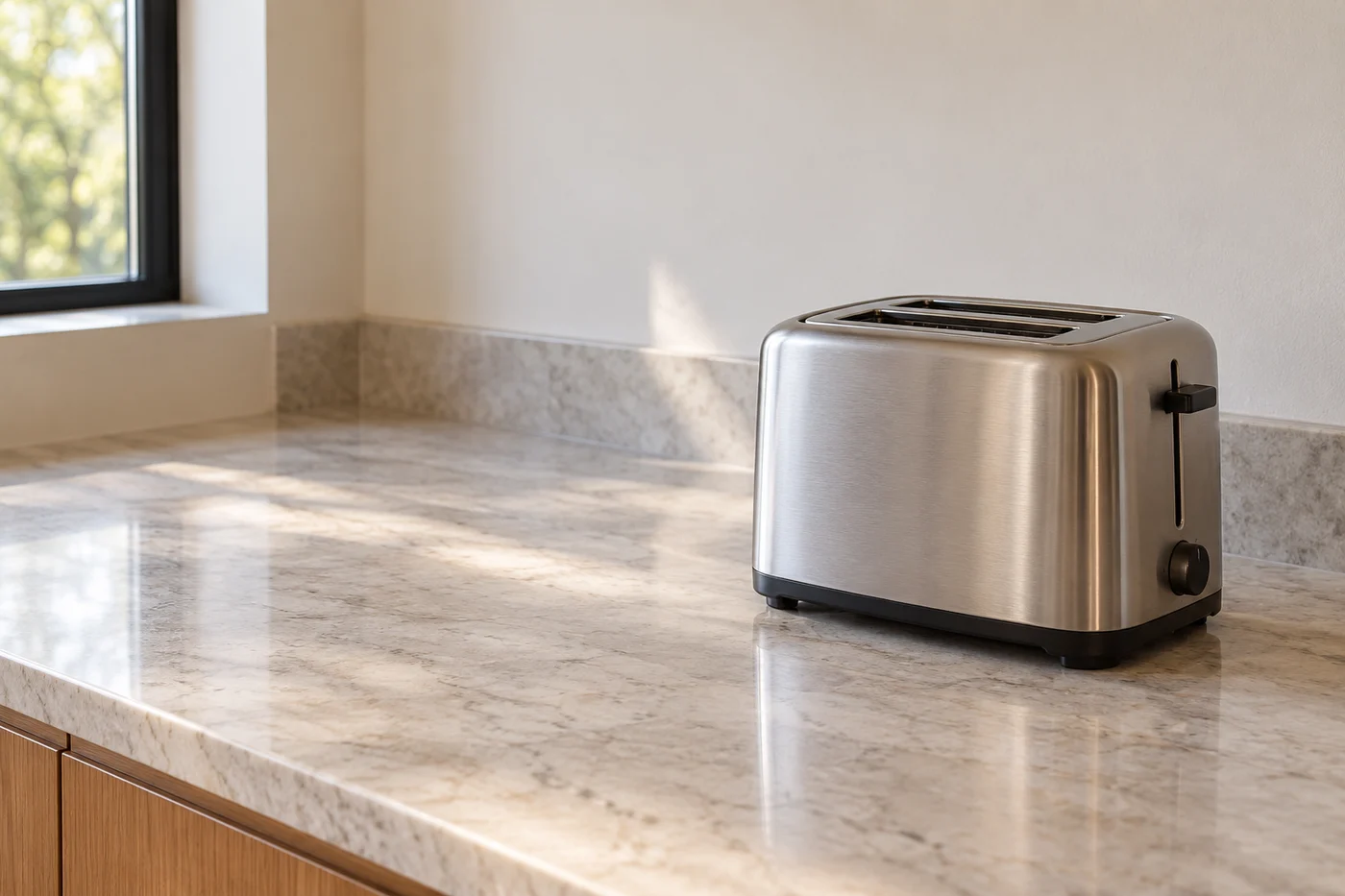
Keep frequent-use equipment near a suitable operating location if the arrangement leaves preparation space. This may mean moving a coffee setup toward one end of the counter, while an occasional blender lives in a cabinet. Check access to sockets and the position of cords without treating an extension lead as a universal solution.
Make the counter decision from the complete setup. A coffee maker may need room to lift a lid, remove a reservoir and place a cup. A stand mixer may need access for its bowl and moving head. Include those actions rather than considering only the machine’s closed dimensions.
If nothing can remain out without blocking preparation, choose the equipment easiest for you to put away and retrieve. If moving a heavy appliance is difficult, solve that handling problem before prioritizing an empty countertop.
Measure the storage footprint and removal path
Measure each appliance in the orientation permitted for storage. Include protruding handles, lids and attached parts. Note whether removable components can be stored separately according to the instructions, and where those parts will go.
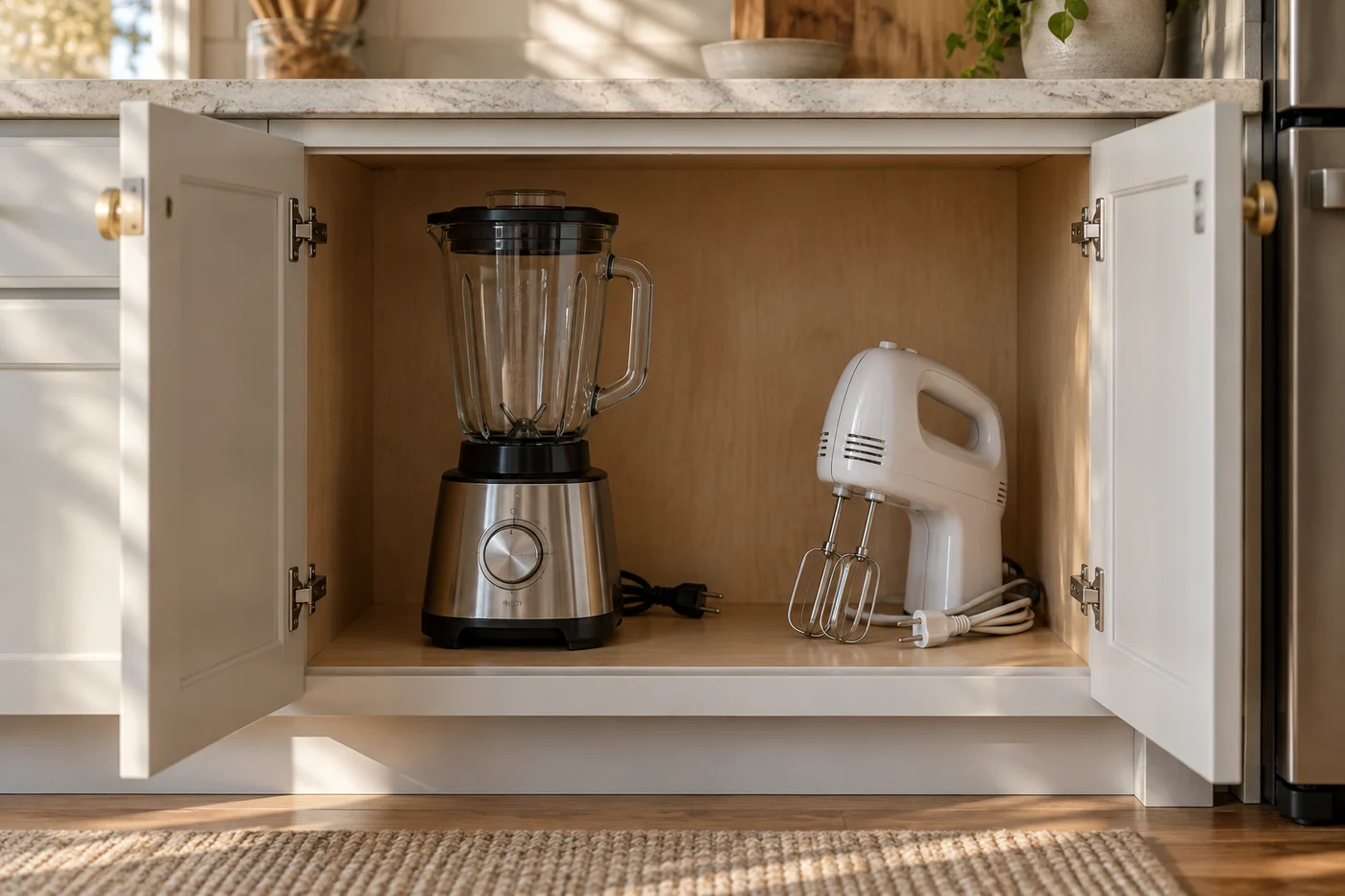
Compare with the cabinet’s usable opening and interior. Hinges, shelves, door frames and pipes can reduce the apparent space. An appliance may fit behind the doors but be impossible to carry through the opening without awkward tilting.
Check where your hands will go when lifting it out. Do you need to move another machine, crouch deeply, or reach over a shelf edge? Assess the path to the counter as well. An empty shelf only counts as useful storage when you can retrieve its contents comfortably.
For a new shelf or cart, verify its load rating, intended configuration and installation requirements. Add the appliance’s accessories to the load you assess. Do not use a photographed arrangement as proof that your shelf can carry the same equipment.
Choose a reachable storage location
| Location | Useful for | Check carefully |
|---|---|---|
| Accessible base cabinet | Equipment you can lift from its height | Door opening, hand access and neighboring contents |
| Existing pantry shelf | Occasional appliances if a pantry exists | Shelf rating and route to counter |
| Open counter location | Frequently used or difficult-to-move equipment | Preparation area and operating requirements |
| Suitable mobile cart | Equipment that needs a nearby storage home | Load rating, stability, wheels and movement route |
| High shelf | Light occasional equipment you can reach safely | Lifting access and container weight |
Heavy equipment should have a location that you can handle safely. That may be the counter or an appropriately placed shelf rather than the highest unused space. Ask for help or choose another arrangement if retrieving the item exceeds your comfortable handling ability.
KitchenAid’s guidance says to store its stand mixer upright and ensure the shelf supports its weight. Check your actual model. Its storage rules do not establish the requirements for an unrelated appliance.
An appliance lift can be a specialized solution, but choosing and installing one requires its own cabinet, load and mounting checks. Do not improvise one from an ordinary pull-out drawer. This guide covers arranging storage, not constructing or modifying cabinetry.
Keep each appliance kit together
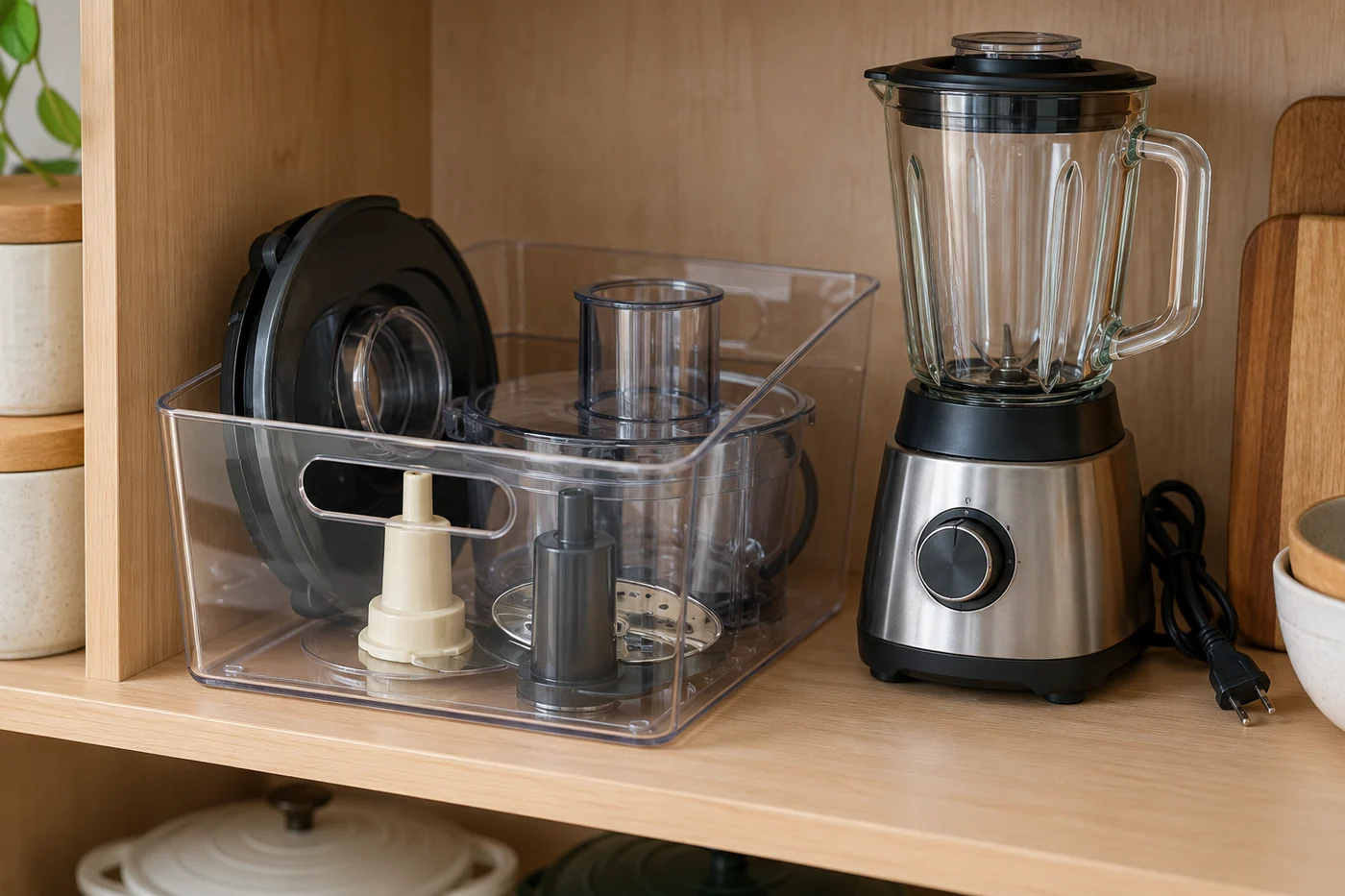
Place compatible accessories near the machine so setting up does not require searching several drawers. Use a small existing bin or designated drawer section to trial the grouping. Choose a location that protects sharp components and follows their handling instructions.
Avoid packing blades loosely among tools someone will reach into without looking. Use the manufacturer’s storage guard or another storage method the instructions permit. Keep labels and parts identifiable when several appliances have similar-looking attachments.
Follow the appliance instructions for cords. Use built-in cord storage when provided, and avoid crushing a cable against a shelf edge or forcing a door closed over it. Do not assume a sticky cord clip can be placed anywhere on a hot or moving appliance surface.
KitchenAid also says not to leave mixer accessories stored on the beater shaft. Store them nearby in an appropriate dry location. Source-specific care directions are more useful than a generic suggestion to hang every attachment on the appliance.
Separate storage from operation
Before use, move equipment to a location allowed by its exact manual. Check required clearances, ventilation, surface suitability and access to controls. Never turn the closed dimensions into a universal operating-space rule.
A cupboard that accepts a cooled appliance is a storage location. Running it there requires explicit manufacturer allowance and an installation that satisfies the relevant requirements. Keeping the door open does not by itself establish adequate ventilation or safe heat clearance.
The same distinction applies to appliance garages, decorative covers and curtains. Move covers and other items as the instructions require. Do not hide operating equipment merely to maintain the counter’s appearance.
If you want a permanent enclosed appliance station, have its design assessed using the manuals and the appropriate installation expertise. Avoid applying one brand’s clearance number to every air fryer, toaster or microwave. Their models and instructions can differ.
Make putting equipment away part of the plan
Follow each appliance’s instructions for unplugging, cooling and cleaning. Put equipment and parts away in the condition the manual requires. For KitchenAid mixers, the manufacturer’s guidance calls for dry components before storage.
Keep the return location available while you work. If you fill the vacant shelf with groceries whenever an appliance is out, putting it away becomes another organization project. Reserve the space for that machine and its kit.
Use the arrangement through a normal recipe. Retrieve the equipment, set it up, prepare food, clean it and return it. Note where you have to shift other objects. Change that specific obstruction rather than buying more organizers.
Reconsider the inventory when your cooking routine changes. An appliance you use more often may move forward; a seasonal item may move to reserve storage. The useful setup is the one that lets you cook and put things away comfortably, not simply the one with the fewest objects visible.