
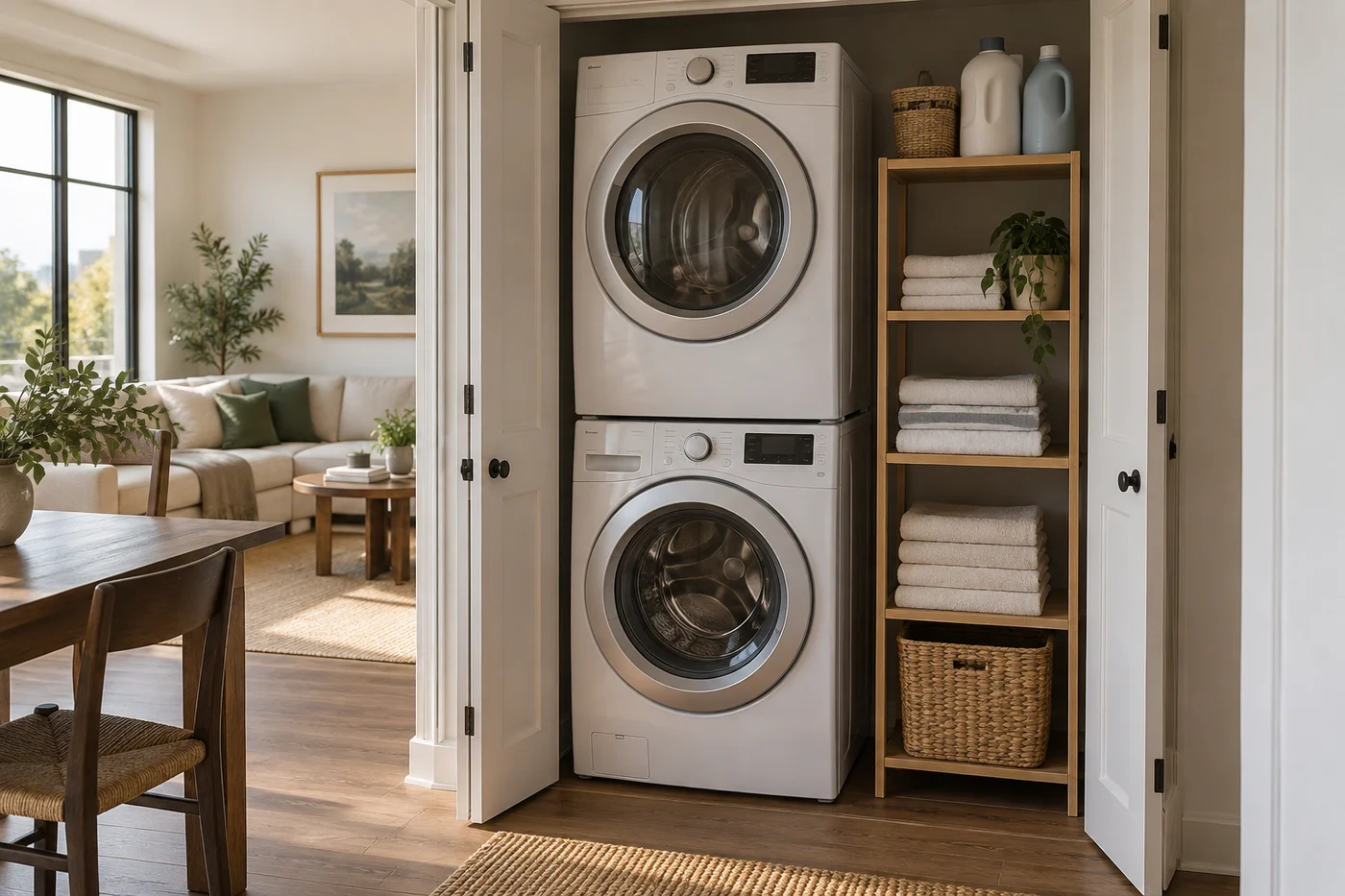
The best starting point for small laundry closet organization ideas is a clear working space around the machines. Keep the supplies you use together in one reachable zone, give the laundry basket a temporary landing place, and leave appliance ventilation and service access unobstructed.
A laundry closet is not a general-purpose cupboard with appliances inside. Your washer and dryer have opening, installation, and maintenance requirements that come before extra storage. Once those are mapped, you can organize the remaining space without relying on a risky gap-filling shortcut.
Mark the space that is already spoken for
Find the model numbers for both appliances and look up their installation instructions. You need the instructions for your actual models, not a photo of a similar closet. Maytag’s manual lookup is one example of how manufacturers provide this information.
Write down the specified clearances and ventilation requirements. Include any requirements for closet doors, rear connections, and service access. Do not apply one brand’s clearance numbers to another machine.
Open the washer and dryer doors completely. For a top loader, include the raised lid. For a front loader, include the space where you stand to reach inside. Open the closet doors too, especially if bifold panels fold into the opening.
Now mark the places you must keep available: the controls, lint filter, detergent drawer, water shutoffs, electrical connection, and any access needed by a service professional. You do not have to expose every connection in plain view, but storage should be removable when access is needed.
Maytag’s laundry closet planning guidance also directs readers to the model’s installation instructions for space behind and between appliances. A narrow visible gap is not automatically a storage slot.
Organize around the steps of one load
Think through the route of a single load: bring clothes in, check pockets, treat any item according to its care instructions, add detergent, transfer the load, and take clean clothes out.
Give each step only the storage it needs. A small tray can serve as a temporary place for items found in pockets. A reachable supply area can hold the detergent you actually use. A basket can arrive with the load and leave with it instead of living permanently on the floor.
Keep this working set smaller than your entire supply collection. Duplicate bottles, spare hangers, and rarely used accessories can occupy another suitable location. The closet should support the next load without making you clear a shelf first.
If two people use the closet, agree on where temporary items go. A forgotten coin or stain-treatment item should have one obvious landing place. Otherwise each person will create a different system on top of the machines.
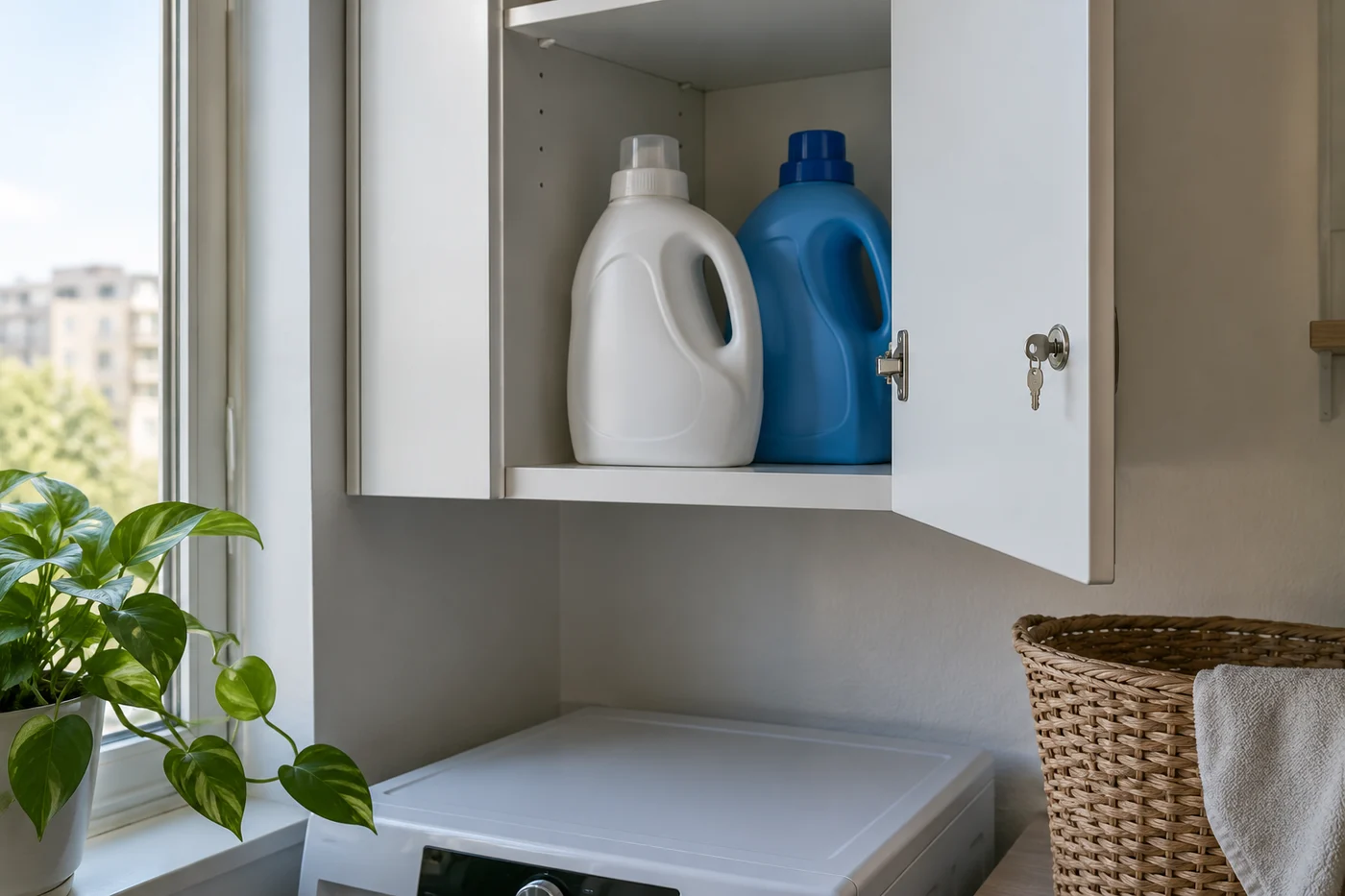
Choose supply storage by reach and package size
Start with the supplies in their original packages. Measure their full height, including pumps and caps, and the room your hand needs to pick them up. A bottle that fits under a shelf but cannot be lifted out is not a useful fit.
Use an existing shelf if it is suitable for the load and easy to reach. Keep the frequently used package toward the front. Put spare supplies elsewhere if reaching them requires leaning over an appliance or standing on a machine.
A removable caddy can group your routine, but it should not become so crowded that you have to remove every bottle to find one. Check the shelf and caddy instructions rather than guessing their load capacity.
Do not decant laundry packets into a decorative jar. CPSC advises keeping packets sealed in their original packaging, locked up and out of children’s sight and reach. A high open shelf is not the same as locked storage. If the closet cannot provide a suitable locked location, store packets elsewhere.
Keep product instructions and warnings available. Follow each package’s storage guidance, and do not put cleaning chemicals into food containers.
Give baskets a temporary landing place
An empty patch of floor may be needed while you load the machine. Preserve that patch if it makes the task easier. Filling it with a permanent hamper can leave you balancing a laundry basket in the doorway.
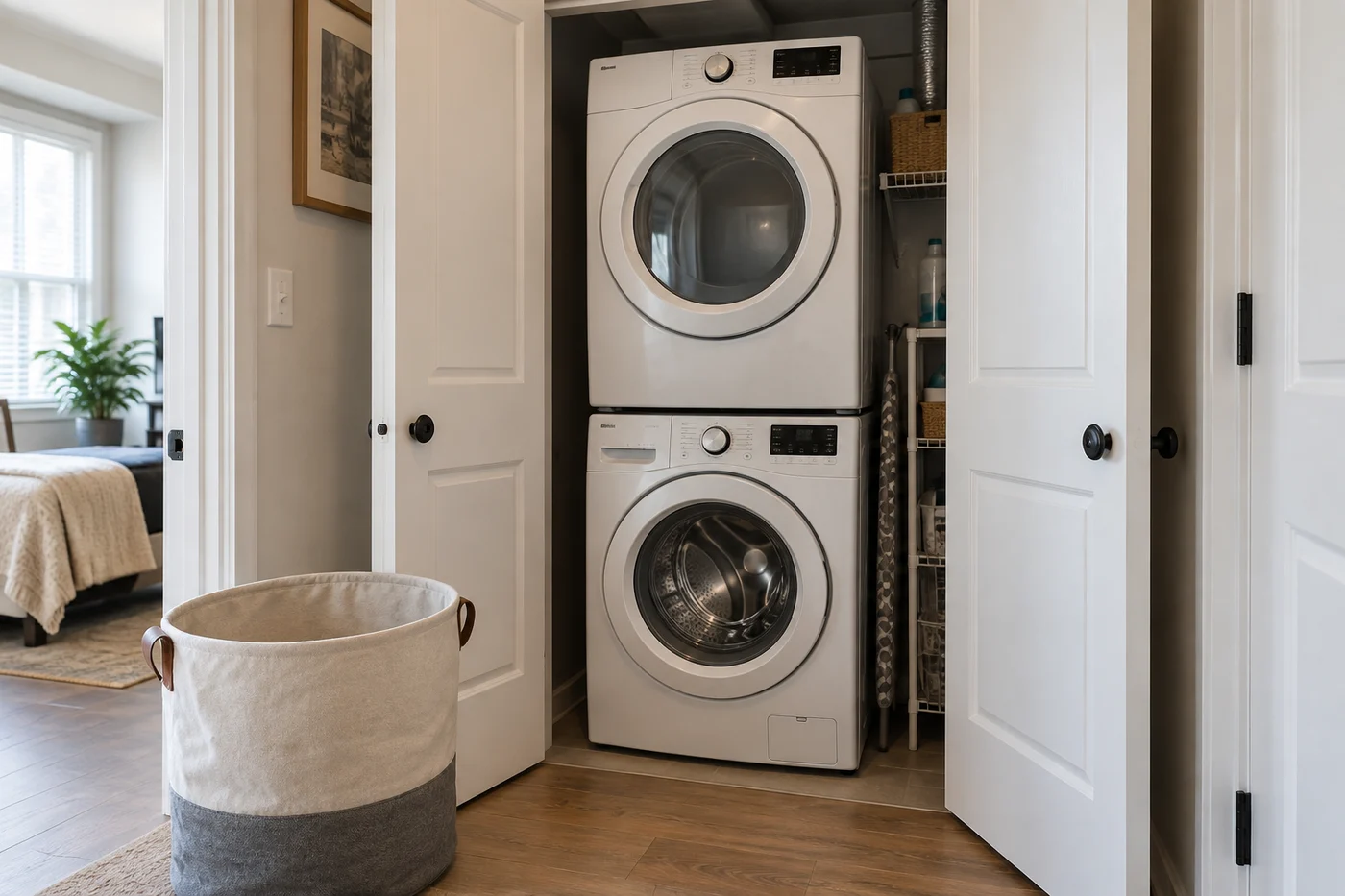
If a basket must stay inside, check the arrangement with the appliance doors open. Slide or lift the basket out using the route you will actually use. A narrow basket behind a door is only helpful when you can retrieve it without moving a loaded machine or blocking ventilation.
Sorting can happen outside the closet. You might sort in a bedroom hamper or carry one selected load to the machine. That approach avoids turning a compact closet into a sorting room.
Keep clean and dirty laundry from becoming indistinguishable. If one basket serves both jobs, return it to its assigned place after the load. If you use separate baskets, distinguish them in a way everyone in the household understands.
Add shelves only in genuinely usable space
The space above appliances may be usable, but first check reach, appliance instructions, and the permitted mounting method. A shelf that sits high above a machine can hold occasional supplies while being a poor location for daily detergent.
Measure the opening needed to place and remove the actual packages. Watch for a shelf edge that interferes with a top-loader lid or the closet doors. Check the weight rating and required fixings before installing anything.
For rental homes, ask permission for an attachment where the lease requires it. Do not substitute adhesive hooks for structural shelf brackets. If installation is unsuitable, reduce the supplies in the closet rather than inventing a mounting workaround.
An over-door organizer is also conditional. It must fit the door, permit closure, and leave ventilation openings unobstructed. A louvered laundry door needs its required airflow; covering the vents with a fabric organizer can defeat the reason for the door’s design.
Keep dryer maintenance separate from storage
The US Fire Administration advises cleaning the lint filter before and after each cycle and checking that dryer venting is not crushed, damaged, or restricted. Its dryer fire-safety guidance also calls for professional installation and servicing.
Keep the lint-filter area accessible. Put the waste container somewhere you can use it without reaching behind equipment. Avoid storing boxes against the dryer vent or wrapping supplies around its connections.
Do not create a makeshift folding surface that rests on hoses, ducting, or controls. Where a shelf or worktop is permitted, use a proper independent installation that follows the appliance and storage system’s instructions.
Keep cords accessible and avoid improvised power arrangements. USFA’s electrical guidance says major appliances should plug directly into a wall outlet, without an extension cord.
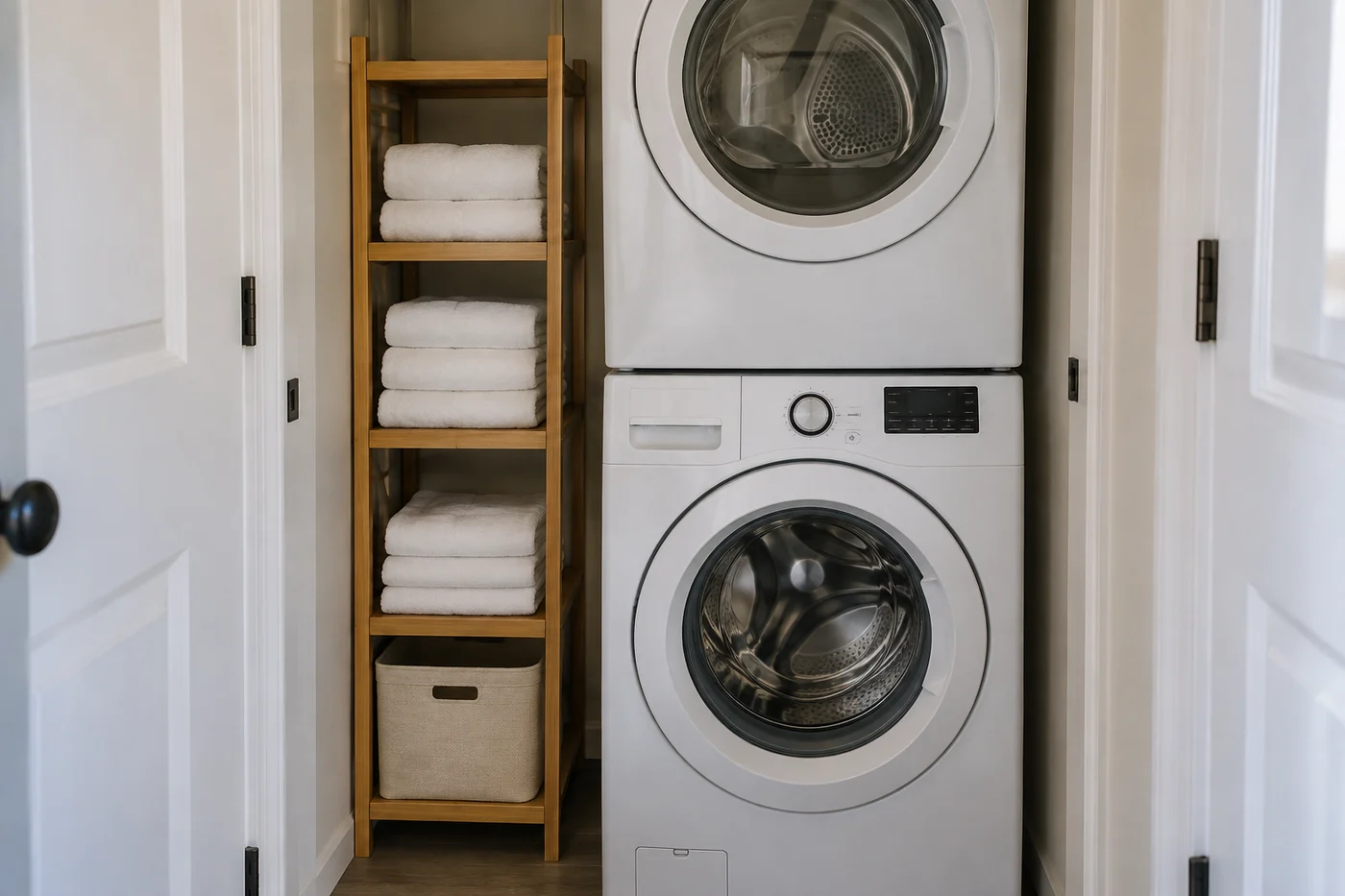
Run a complete load before calling the layout finished
Use the closet for a normal laundry sequence. Notice where you pause to move a bottle, find a basket, reach the controls, or clear the door. Those pauses tell you which part of the organization needs adjustment.
Move the frequently used supply closer if the current position is awkward. Remove a spare bottle if the caddy is difficult to lift. Move sorting outside the closet if the basket blocks the opening. Keep these changes reversible while you learn what suits the routine.
For lightweight fabric accessories, over-door storage may offer another option when the door and organizer are compatible. Keep detergent and other cleaning products in the storage required by their labels, and preserve the laundry door’s normal operation.
Common questions
Can you store supplies between the washer and dryer?
Only when the actual appliance instructions allow the arrangement and required clearance, ventilation, connections, and service access remain available. There is no universal safe gap for every pair of machines.
Does every laundry closet need a folding station?
No. If a work surface makes the appliances or doors difficult to use, fold elsewhere. Keeping the closet functional is more valuable than squeezing every laundry step into it.